International Programmes 2026/2027

Science Communication Science Communication

Ansbach University of Applied Sciences • Ansbach

Degree
Master of Science
Course location
Ansbach
Teaching language
  • English
Languages

Courses are held in English (100%).

Full-time / part-time
  • full-time
Programme duration
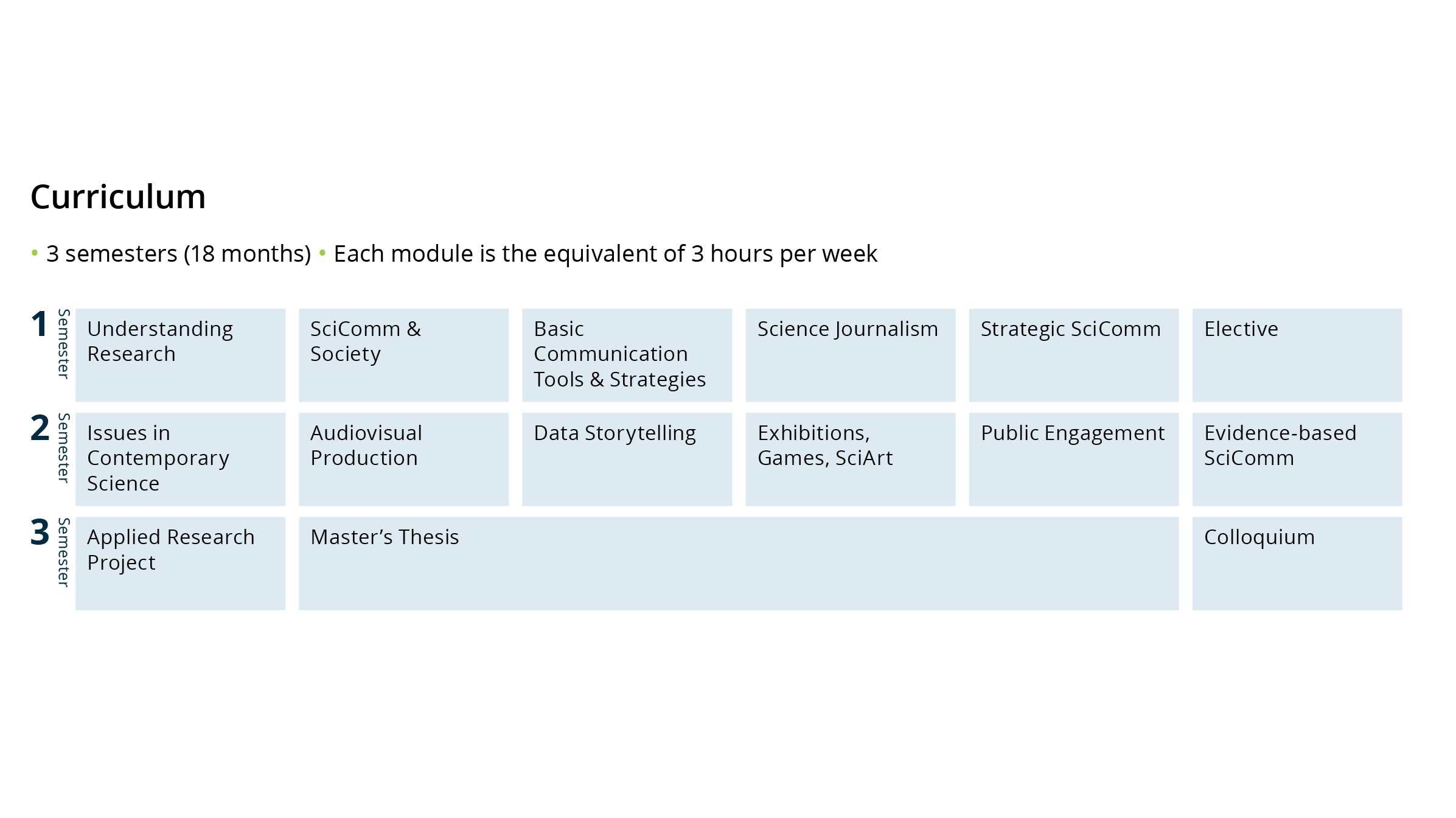
3 semesters
Beginning
Winter semester
Application periods
The following is valid for applicants from: all countries
For the winter semester:
1 May - 30 June
More information on application periods
Please find more details on this website.
Combined Master's degree / PhD programme
No
Joint degree / double degree programme
No
Description/content

In this three-semester programme, students don't just learn how to communicate science well; they also learn to distinguish good from bad quality research and how to communicate uncertainty and the process of scientific discovery as an honest broker, without under- or overstating scientific findings.

Beyond that, students 

  • learn both strategic and journalistic communication of findings not only from natural sciences, but also from social sciences and humanities;
  • study and practice traditional communication through text, audio and video, as well as innovative approaches such as data visualisation, virtual reality, or game and exhibition design;
  • learn to find ways to connect with audiences who are sceptical of the findings of credible science;
  • learn to make their own communication more reliable, for example by pre-publication fact checking or by addressing biases or conflicts of interest;
  • understand how to involve their audience through public engagement projects, and explore what communication research has found about which communication strategies are the most effective.

Case studies and international guest speakers will connect what students have learned to the real world and show them the many possible career paths.

In their Master’s thesis in the third semester, students either showcase what they have learned in a larger communication project, or they conduct an academic study to answer a communication research question with practical relevance for working journalists or science communicators.

As a result, the programme prepares graduates for the international science communication job market in areas including the following:

  • Science journalism
  • Public relations for companies, non-profits, think tanks or governments
  • Advertising in areas that use scientific knowledge (for example medical)
  • Science diplomacy
  • Exhibition design in places like museums
  • SciArt (communicating science through art)
  • Public engagement
  • Game design
Course organisation
PDF Download
A Diploma supplement will be issued
Yes
International elements
  • International guest lecturers
  • Courses are led with foreign partners
Course-specific, integrated German language courses
No
Course-specific, integrated English language courses
No
Tuition fees per semester
The following tuition fees apply for applicants from: non-EU countries
1,000 EUR
More information on tuition fees
Please find more details on this website.
Semester contribution

72 EUR per semester

Funding opportunities within the university
No
Academic admission requirements
  • A completed university degree equivalent to 180 ECTS with a minimum GPA of 2.5 on the German grading scale in relevant fields like natural or social sciences, humanities, communication, journalism, or arts (Applicants with fewer than 210 ECTS must complete additional coursework or internships to make up the difference.)
  • Proof of English proficiency at C1 level 
  • A portfolio of at least three, ideally published, examples of science communication directed at non-expert audiences (articles, videos, podcasts, or creative projects)
  • A motivation letter of up to 1,000 words in English explaining why you wish to enter the field of science communication, how your previous experience has influenced this decision, and what you expect to gain from a Master’s degree in this field
German language skills
No minimum language level required
English language skills
C1 required, please provide an official language certificate, e.g.:
  • TOEFL iBT (before 2026): 100
  • Reading: 25
  • Listening: 25
  • Speaking: 25
  • Writing: 25
  • IELTS Academic: 7
Language requirements exemptions
Please find details on the course website.
Application periods
The following is valid for applicants from: all countries
For the winter semester:
1 May - 30 June
More information on application periods
Please find more details on this website.
Submit application via
Please check this website.
Accommodation

You can find valuable information regarding accommodation on our website.

If you click on “Halls of residence”, you will find a list of dormitories where you can apply by following the links to the respective websites and completing the application forms.

Another option is "Private Placement of Flats", where you can also take a look.

Also make sure to check online housing portals.

Career advisory services and programmes for future professionals

https://www.hs-ansbach.de/en/service/career-service/

Support for international students and doctoral candidates
  • Welcome event
  • Buddy programme
General services and support for international students and doctoral candidates

https://www.hs-ansbach.de/en/info/welcome-center

Ansbach University of Applied Sciences

University location

Activate map

To activate the map, click on the "Show map" button. We would like to point out that data will be transmitted to OpenStreetMap after activation. You can find out more in our privacy policy. You can revoke your consent to the transmission of data at any time.