International Programmes 2026/2027

One Health One Health

Justus Liebig University Giessen • Gießen

Degree
Master of Science
Course location
Gießen
Teaching language
  • English
Languages

The course language is English. The Master's thesis has to be submitted in English.

Full-time / part-time
  • full-time
Programme duration
4 semesters
Beginning
Winter semester
Application periods
The following is valid for applicants from: all countries
For the winter semester:
1 May - 15 June
More information on application periods
Please find more details on this website.
Combined Master's degree / PhD programme
No
Joint degree / double degree programme
No
Description/content

The Master’s programme One Health offers an interdisciplinary approach to understanding the interconnections between human, animal, and environmental health. Students are introduced to core concepts of One Health and Planetary Health and develop a critical perspective on global health challenges.

Central topics include Public Health, Public Health Nutrition, and Infectious Diseases, covering health systems, non-communicable diseases, zoonoses, prevention strategies, and social and environmental determinants of health. You will learn about environmental risk assessment, sustainability, land use, animal husbandry, and their impacts on ecosystems, animal health, and food systems.

Comprehensive training in research methods, statistics, epidemiology, and data analysis equips you with essential skills for evidence-based practice. Throughout the programme, an interdisciplinary perspective fosters critical thinking and global awareness.

Career opportunities can be found in international organisations, public health/one health, research institutions, NGOs, or private sectors such as health or environmental management. Due to the scientific focus of the programme, graduates are also well qualified for doctoral programmes.

Course organisation

The study programme is organised in modules (courses). Each module comprises four semester hours per week and is completed with a final examination. The final grade of the study programme is calculated from the achieved module grades.

The course consists of 10 mandatory modules (core modules), which can be deepened or broadened in six optional modules (profile modules). Two profile modules can be replaced by a work placement in order to gain initial professional experience.

Having completed the core modules, the students are well equipped with a solid scientific education and ready to deepen their knowledge in specific research areas. By individually choosing their profile modules from a diverse range of study areas, students shape their individual competence profiles.

Core Modules (mandatory):

  • Introduction to One Health
  • Critical Public Health
  • Public Health Nutrition and Non-Communicable Diseases (NCDs)
  • Empirical Research Methods
  • Antibiotics: Past, Present and Future
  • Sustainable Animal Nutrition and Husbandry
  • Environmental Chemistry and Ecotoxicology
  • Biostatistics and Epidemiology
  • Infectious Diseases in Animals
  • Planetary Thinking

Programme schedule:

PDF Download
A Diploma supplement will be issued
Yes
Integrated internships

The programme offers a voluntary work placement that enables our students to gain an initial insight into the various areas of professional activity in which they hope to pursue in the future. The work placement also enables them to collect hands-on professional experience and establish contacts with potential employers. The variety of contacts that our faculty possesses allows us to provide expert support to students seeking a work placement.

Course-specific, integrated German language courses
No
Course-specific, integrated English language courses
No
Tuition fees per semester
None
Semester contribution

403 EUR (summer semester 2026, varies slightly with each semester)

The current semester contribution can be found here: https://www.uni-giessen.de/en/org/admin/departments/b/5/studoffice/sc.

Funding opportunities within the university
Yes
Description of the above-mentioned funding opportunities within the university
Academic admission requirements

Admission to the One Health Master's programme requires a Bachelor's degree with a duration of at least three years (180 credits) or a comparable degree. The Bachelor's degree must be completed in a closely related scientific field. For example:

  • BSc Agricultural Biology ("Agrarbiologie")
  • BSc Agricultural Economics ("Agrarwirtschaft")
  • BSc Agricultural Sciences ("Agrarwissenschaften")
  • BSc Nutritional Sciences ("Ernährungswissenschaften")
  • BSc Geography ("Geografie") 
  • BSc Global Health
  • BA Health Sciences ("Gesundheitswissenschaften")
  • BSc Crop Biomass and Bioresources ("Nachwachsende Rohstoffe und Bioressourcen")
  • BSc Agriculture ("Landwirtschaft")
  • BSc Organic Agriculture ("Ökologische Landwirtschaft") 
  • BSc Nutritional Sciences and Home Economics ("Ökotrophologie")
  • BSc Public Health
  • BSc Animal Sciences ("Tierwissenschaften")
  • BSc Environment and Global Change ("Umwelt und globaler Wandel")
  • BSc Environmental Management ("Umweltmanagement")
  • BSc Environmental Sciences ("Umweltwissenschaften")
  • Bachelor of Medicine
  • Bachelor of Veterinary Medicine

Applications with a Bachelor’s degree in another scientific field or with a Bachelor’s degree from abroad will be examined individually as to whether the study requirements are fulfilled. A specialist commission at Justus Liebig University Giessen (JLU) will then finally decide on the admission. Any information on the status of acceptance without having completed the application process is not possible.

Detailed information about the application process is provided here: https://www.uni-giessen.de/en/faculties/f09/studies/general.

German language skills
No minimum language level required
English language skills
C1 required, please provide an official language certificate, e.g.:
  • UNIcert® English: UNIcert® III
  • telc English: telc English C1
  • TOEIC: 945
  • PTE Academic: 76
  • Cambridge English Qualifications: C1 Advanced
  • IELTS Academic: 7
  • TOEFL iBT (before 2026): 95
Language requirements exemptions
Please find details on the course website.
Application periods
The following is valid for applicants from: all countries
For the winter semester:
1 May - 15 June
More information on application periods
Please find more details on this website.
Submit application via
Please apply via uni-assist.
Accommodation

The cost of accommodation in Giessen ranges between 400 and 500 EUR/month on average. Students usually live in halls of residence provided by the Student Union (Studierendenwerk Giessen) or in shared flats from the private housing market.

Accommodation in the halls of residence is available between 240 and 420 EUR per month. The rooms are fully furnished and equipped with gas, electricity, warm water and internet. Students may apply for a spot in the halls of residence or search for private accommodation, ideally three to four months before starting their studies.

More information via www.uni-giessen.de/en/international-pages/study/around-gi/accommodation/where-to-live-in-giessen

Career advisory services and programmes for future professionals

Career Service and special opportunities for international students: www.uni-giessen.de/en/faculties/research-centers/zfbk/career_services/

Support for international students and doctoral candidates
  • Welcome event
  • Cultural and linguistic preparation
  • Visa matters
  • Help with finding accommodation
  • Support with registration procedures

Justus Liebig University Giessen

Content Bild
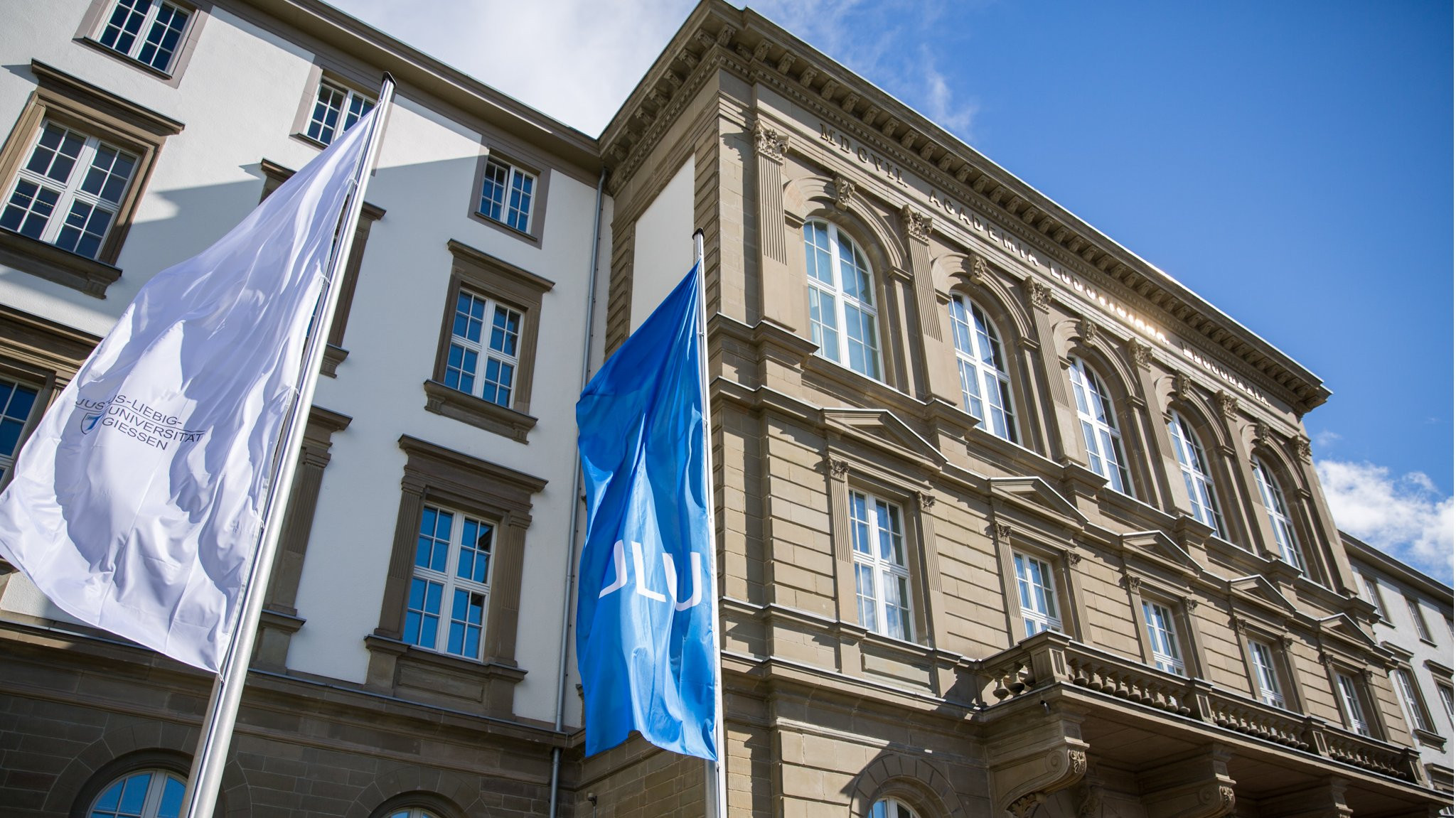
The main building of JLU © JLU/Sebastian Ringleb

Founded in 1607, Justus Liebig University Giessen (JLU), Germany, is a comprehensive university with a longstanding tradition which attracts around 25,000 students. JLU offers the full range of traditional and modern subjects with top-level teaching and research — extending from classical natural sciences, law and economics, social and educational sciences, linguistics and cultural studies to a unique selection of life science subjects such as human and veterinary medicine, agricultural, environmental and nutritional sciences and food chemistry. The leading personae who carried out research and taught at JLU include a number of Nobel Prize winners, such as Wilhelm Conrad Röntgen (Nobel Prize for Physics in 1901) and Wangari Maathai (Nobel Peace Prize in 2004). Since 2006, research at JLU has received continuous funding from the Excellence Initiative schemes and the Excellence Strategy of the German Federal Republic and Federal States.

University location

With around 94,000 inhabitants, Giessen has one of the highest student densities throughout Germany. Four higher education institutions with altogether 40,000 students provide a unique university-town atmosphere. The city offers plenty of leisure options for students, such as canoeing on the Lahn river, walks and picnics in its multiple green areas, cinemas with student concession tickets, the municipal theatre with a programme consisting of plays, opera and ballet as well as swimming pools and sports facilities, and a variety of pubs, restaurants and night life venues. The great thing about Giessen is that it's an easy place to navigate and, when the mood takes you, to escape into the picturesque surrounding countryside or the metropolis of Frankfurt am Main, which is about 60 kilometres away.

Activate map

To activate the map, click on the "Show map" button. We would like to point out that data will be transmitted to OpenStreetMap after activation. You can find out more in our privacy policy. You can revoke your consent to the transmission of data at any time.