All courses are taught in English. The working language in all research groups is English.
The University of Siegen offers a Master’s programme in Physics with a duration of four semesters. Students can tailor their curriculum to our three focus areas: particle physics, solid state physics, and quantum optics and quantum information.
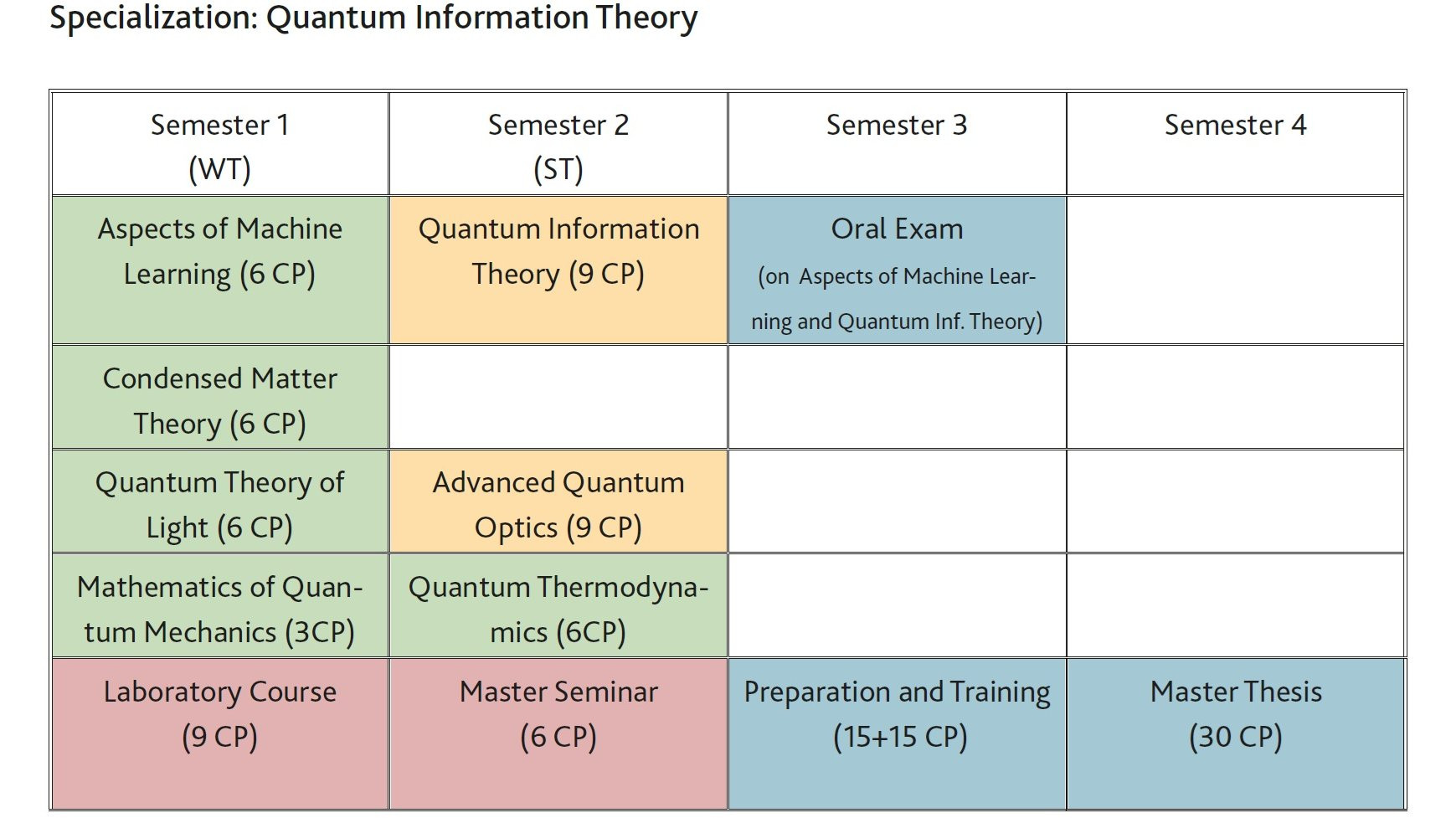
General Information: The MSc in Physics is a research-oriented study programme. During the first year, students attend elective lectures, lab courses, and seminars. In the second year, students carry out a project in one of the research groups, leading to the Master's thesis. The programme language is English. Admission is possible each year in spring and autumn.
Research: At the Department of Physics, about 300 students and 20 professors work together, resulting in an outstanding student-to-staff ratio. Our research groups work on:
- Experimental particle & astroparticle physics
- Theoretical particle physics
- Experimental quantum optics with trapped ions
- Experimental quantum & nano-optics
- Theoretical quantum optics & quantum information theory
- Experimental solid state physics
- Experimental x-ray methods
We are part of numerous international collaborations, giving young students the chance to work directly on challenging problems in cutting-edge research, such as:
- Exploring the fundamental nature of matter and new phenomena in strong and weak interactions, as part of the cluster of excellence "color meets flavor"
- Challenging the Standard Model of particle physics through precision calculations for experiments at the energy and intensity frontier, as part of the CRC "particle physics phenomenology after the Higgs discovery"
- Exploring and developing novel concepts and methods for quantum information processing with trapped ions, in cooperation with the local quantum industry pioneers at eleQtron GmbH and research partners worldwide
- Probing the limits of quantum theory with matter waves and macroscopic quantum effects, together with leading experimental groups in Europe
- Detector development for the world’s largest particle accelerator at CERN, the world’s largest cosmic rays experiment in Argentina, and for medical imaging
- Understanding the nature of entanglement, its role in quantum networks, and practical applications, as part of European quantum information science initiatives
- Development of quantum sensors and single-photon sources based on colour centres and optical nanostructures
- Preparing and characterising novel, ultra-thin 2D materials as the ultimate limit of device miniaturisation
- Facilitating the development of new materials with cutting-edge x-ray methods at large-scale x-ray facilities in Germany, Europe and the world