International Programmes 2026/2027

Power Engineering Power Engineering

Brandenburg University of Technology Cottbus-Senftenberg • Cottbus

Degree
Master of Science
Course location
Cottbus
In cooperation with

A double degree option is possible in cooperation with one of our partner universities:

  • University of Shanghai for Science and Technology
  • Shanghai University of Electric Power
  • North China Electric Power University (Beijing)
  • National Cheng Kung University (Tainan)
  • Wrocław University of Science and Technology
Teaching language
  • English
Languages

All courses are held in English.

Programme duration
4 semesters
Beginning
Winter semester
Application periods

Please check https://www.b-tu.de/en/powerengineering-ms.

More information on application periods
Please find more details on this website.
Combined Master's degree / PhD programme
No
Joint degree / double degree programme
Yes
Description/content

This Master's programme aims to convey knowledge of sustainable energy supply in the European context. The main focus of teaching centres on the concept of safe, affordable, and environmentally friendly energy generation as one of the most urgent global challenges of the 21st century. The programme cooperates closely with regional and national energy providers in order to ensure practically-oriented training, which should enable students to conduct independent and applied research. The programme covers the entire spectrum of energy research in the field of traditional as well as renewable energies and adopts a strong industry-oriented approach, with a part of the lectures and seminars delivered by industry professionals.

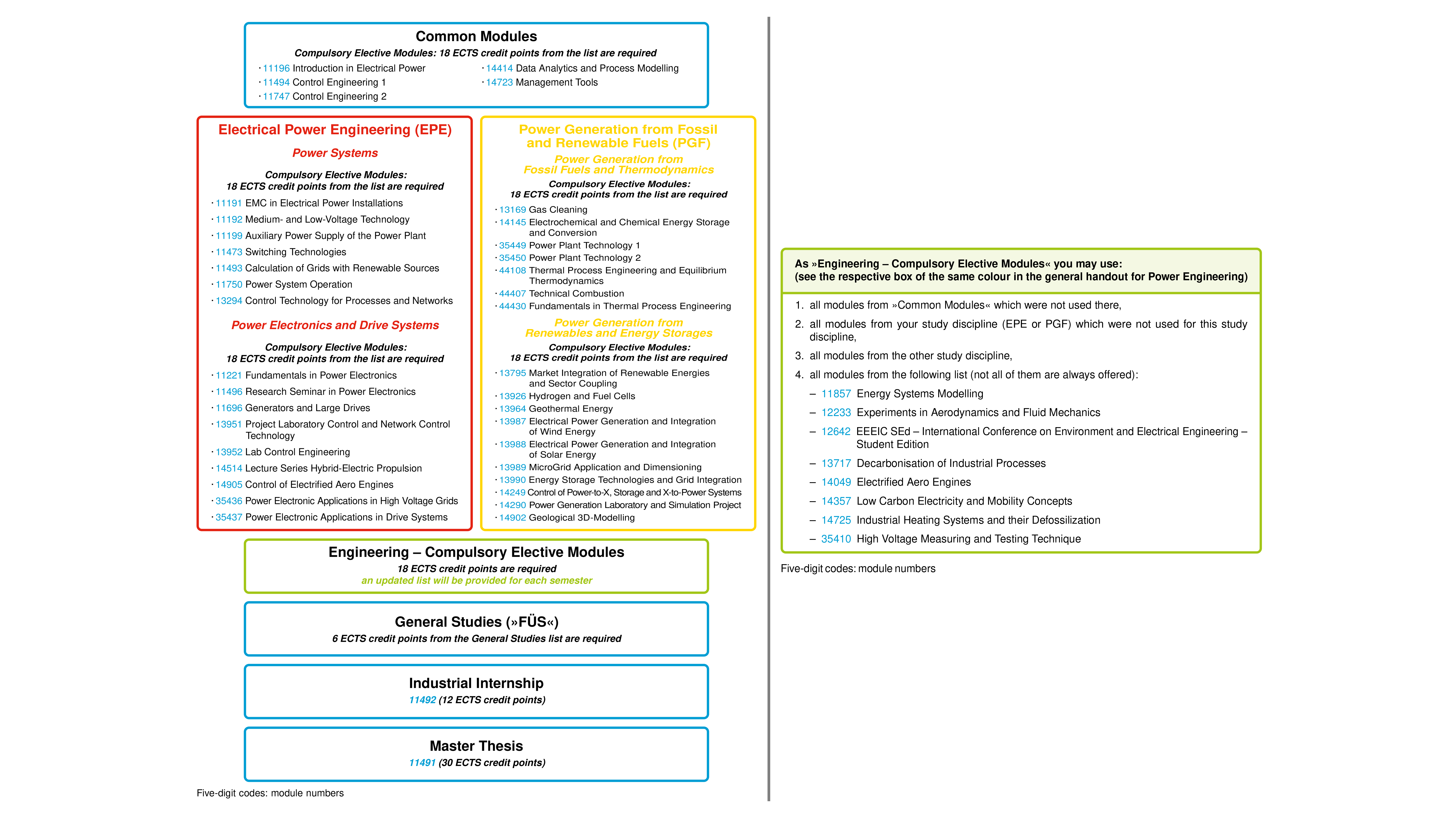
Within the Power Engineering programme, there are the following two specialisations: Electrical Power Engineering (EPE) and Power Generation from Fossil and Renewable Fuels (PGF).

The specialisation must already be specified during the application process.

For further information, please visit: https://www.b-tu.de/en/powerengineering-ms.

Course organisation

A Master of Science (MSc) degree will be awarded after the successful completion of the programme. The programme is supported by a global network of cooperating universities and industrial enterprises.

In addition to coursework in the above-mentioned focus areas, the programme includes elements of general studies and practical work, excursions, special seminars, and work on a final Master's thesis.

The module structure of the course includes 18 mandatory CPs in common modules, 36 mandatory CPs in subject-specific modules, 18 mandatory CPs in compulsory elective modules, and 6 CPs in general (interdisciplinary) modules, as well as a mandatory internship and Master's thesis components.

The Master's programme Power Engineering at BTU Cottbus-Senftenberg has signed double degree agreements with partner universities in China, Poland, Russia, and Taiwan. BTU students enrolled in the first semester for Power Engineering at BTU may apply for one of these double degree offers. Upon successful completion of the semesters at BTU and the semesters at the partner university (120 ECTS credits including the Master's thesis), both universities award a Master's degree. The two universities will clearly state in the relevant documents (diploma supplement, certificate, transcript of records) that the awarded degree is part of a double degree Master's programme between the partner university and BTU Cottbus-Senftenberg.

PDF Download
A Diploma supplement will be issued
Yes
International elements
  • International guest lecturers
  • Courses are led with foreign partners
  • Projects with partners in Germany and abroad
  • International comparisons and thematic reference to the international context
  • Opportunities for students to work abroad
  • Specialist literature in other languages
Description of other international elements
  • Master's theses with international partners are possible.
  • All courses are held in English.
Integrated internships
  • There is a mandatory internship in the programme.
  • An external Master's thesis is possible.
Course-specific, integrated German language courses
No
Course-specific, integrated English language courses
No
Tuition fees per semester
None
Semester contribution

Apart from a few degree programmes, education offered at the BTU Cottbus-Senftenberg is without tuition fees. However, the university does charge a semester fee each semester (currently: winter semester 2026/27: 391.80 EUR). This covers costs for student services organisation, the Student Council as well as the semester ticket.

Costs of living

Studies abroad often have different types of expenses from the ones you know from your home country. You are responsible for covering your own living expenses. Accommodation and other essential living expenses will amount to around 780 to 1,000 EUR per month. Of course, this amount depends entirely on individual lifestyle. The following list gives you an idea of some fixed and variable costs that you should take into account for your stay in Germany.

Monthly costs:

  • rent (including utilities): 250 to 450 EUR
  • groceries: approx. 160 to 180 EUR
  • health insurance, medical fees, medication: approx. 145 EUR
  • miscellaneous (clothing, study materials, other activities): 170 to 220 EUR

Total: 780 to 1,000 EUR

The so-called "Deutschlandticket" included in the semester ticket allows you to travel using all local public means of transportation throughout Germany.

Funding opportunities within the university
Yes
Description of the above-mentioned funding opportunities within the university

Studying at BTU is mostly free of (tuition) fees. Because of this, there are only limited scholarship opportunities for international students. The International Relations Office is nonetheless pleased to be able to award a limited number of scholarships to international students already enrolled at BTU. You can find more information on BTU scholarship opportunities on our websites.

Academic admission requirements

A Bachelor's degree in a power engineering-related field which includes:

  • Basic areas of Mathematics, Physics, Computer Science, Basics in Electrical or Mechanical Engineering and
  • Electric Power Systems, Electrical Machines, Drive Systems, Power Electronics, High Voltage Engineering, Grid Calculation – in case a student wants to apply for the Electrical Power Engineering (EPE) specialisation or
  • Thermodynamics, Thermal Power Engineering, Power Plant Technology, Heat Transfer, Renewable Energies – in case a student wants to apply for the Power Generation from Fossil and Renewable Fuels (PGF) specialisation
German language skills
No minimum language level required
English language skills
B2 required, please provide an official language certificate, e.g.:
  • IELTS Academic: 6
  • TOEFL iBT (before 2026): 79
  • Cambridge English Qualifications: C1 Advanced
  • UNIcert® English: UNIcert® II
Language requirements exemptions
Please find details on the course website.
Application periods

Please check https://www.b-tu.de/en/powerengineering-ms.

More information on application periods
Please find more details on this website.
Submit application via
Please check this website.
Possibility of finding part-time employment

There are job opportunities both in town and on campus. Nevertheless, please do not come to Germany expecting to be able to finance your entire studies by working. The study load is high, it is not always easy to find a part-time job and you will need at least basic German skills for many of the available jobs. Students from non-European countries are allowed to work either 120 whole days or 240 half days annually. The 120-day rule is not affected by mandatory internships or student assistance jobs at university. Students from EU member countries, the European Economic Area (EEA) and Switzerland can work without restrictions during their studies in Germany.

Accommodation

BTU Cottbus-Senftenberg is a university with three locations where numerous student dormitories are provided. Students can choose between different room types. The room capacities in our dormitories are limited, thus we recommend to apply as early as you receive your admission letter for an apartment in the dormitories.

In Germany, it is also very common for students to live alone or with friends. If three or more people share an apartment together, this is called a "WG" in German ("Wohngemeinschaft", which means a shared flat). A comprehensive list on student accommodation and housing options at BTU's three locations can be found on our websites, as well as a video about how students live in both Cottbus and Senftenberg.

Career advisory services and programmes for future professionals

The BTU Career Center offers extensive support to international students and graduates, ensuring that students experience a smooth transition into the job market. We help students on their journey to a successful career path by offering seminars, workshops and career advisory services to ensure that students succeed in their job application processes and land great positions.

Our offers include:

  • BTU Job Market: online job board for students
  • BTU Campus-X-Change and BTU Matching Day: annual job fair and online recruiting event to connect students with employers
  • FIT@BTU: a DAAD-funded project that helps students make the transition to a successful career
  • Start up your Career in Brandenburg: a project co-financed by the EU and Brandenburg, with the aim of preparing international students for the Brandenburg job market
Support for international students and doctoral candidates
  • Welcome event
  • Buddy programme
  • Support with registration procedures
  • Accompanying programme
  • Cultural and linguistic preparation
General services and support for international students and doctoral candidates

BTU offers a wide range of support during your preparation for your stay in Germany, your first days on campus and throughout your whole study programme.

Among others, the International Relations Office offers the following services:

Brandenburg University of Technology Cottbus-Senftenberg

Content Bild
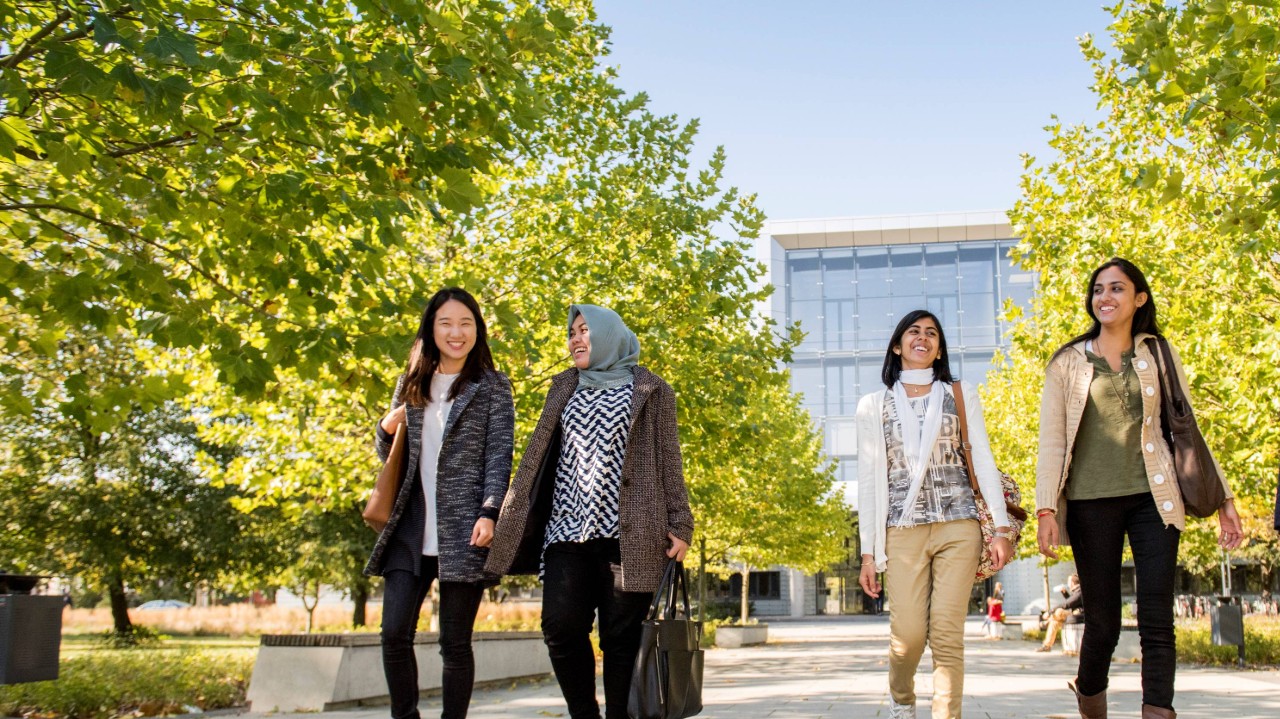
The BTU welcomes you to start your academic journey! © BTU

Located on three campuses and with over 70 study programmes, BTU Cottbus-Senftenberg offers a broad spectrum of market-oriented programmes as well as traditional degree programmes.

From the natural sciences and engineering to economics, cultural studies, and even health sciences, BTU offers a wide range of courses. Our 21 study programmes taught exclusively in English are very popular among both German and international students from all over the world.

BTU is partnered with over 220 universities throughout the world, which provides students with a multitude of excellent opportunities to spend part of their time studying or conducting research abroad. Furthermore, in cooperation with our international partner universities, BTU offers a wide range of double degree and joint degree programmes.

45% International students study at BTU.
130 Nationalities

University location

Cottbus is located in the northeast of Germany, between the country’s capital, Berlin (100 km), and Dresden (120 km). With a population of approx. 100,000 inhabitants, Cottbus is the second largest city after Potsdam in the federal state of Brandenburg. The Polish border is only approx. 30 km away. The location of Cottbus offers a convenient starting point for trips into the picturesque region of Lower Lusatia. The landscape of Lower Lusatia is characterised by the Spreewald with its small canals and waterways as well as by the Slavonic minority called Sorbs or Wends. Their language, similar to Polish, is still used and spoken in Lower Lusatia. For this reason, many of the road signs and informational boards in Cottbus and the surrounding region are written in both Sorbian and German. 

Cottbus gained importance as a trade centre in the 12th century. Parts of the original city wall from the 14th century as well as the beautiful townhouses around the old market square are proof of the city’s early splendour. Additionally, the city is characterised by buildings from the "Wilhelminian" times of rapid industrial growth in Germany, which occurred towards the end of the 19th century. The city that first rose to prominence with its cloth and linen weaving industry soon evolved into a growing centre of brown coal mining. Today, Cottbus is in the midst of a structural transformation. BTU supports this development with its engagement in the Lausitz Science Park megaproject, which aims to build an appealing innovation landscape.

Senftenberg is the centre of the Lusatia Lake District. Former excavation and mining pits have been flooded in order to create the largest artificial lake system in Europe, with a total of 23 large lakes. The water sports area "Senftenberger See", with its water surface of 1,300 hectares, offers exceptional sailing and surfing opportunities, and it is suitable for all kinds of water sports. Senftenberg has thus become a tourist attraction within the region.

Activate map

To activate the map, click on the "Show map" button. We would like to point out that data will be transmitted to OpenStreetMap after activation. You can find out more in our privacy policy. You can revoke your consent to the transmission of data at any time.