International Programmes 2026/2027

Master of Science in Quantitative Finance MSc in Quantitative Finance

Kiel University • Kiel

Degree
Master of Science
Course location
Kiel
Teaching language
  • English
Languages

In the compulsory sections of the programme, all lectures and examinations are held in English.

In the supplementary subject, some lectures and examinations may be held in German. However, it is always possible to choose subjects that are completely held in English. "German as a foreign language" offers non-native speakers the chance to learn German. No prior knowledge in German is needed.

Full-time / part-time
  • full-time
Programme duration
4 semesters
Beginning
Winter and summer semester
Application periods

Application period with a Bachelor's degree obtained in other countries via uni-assist:

  • Winter semester: 1 April – 31 May
  • Summer semester: 1 October – 30 November

Application period with a Bachelor's degree obtained in Germany via Kiel University:

  • Winter semester: 1 June to 1 August
  • Summer semester: 1 December to 1 February
More information on application periods
Please find more details on this website.
Combined Master's degree / PhD programme
No
Joint degree / double degree programme
No
Description/content

The MSc in Quantitative Finance enables you to deepen your understanding of financial markets. It provides a sound platform for a career in the finance sector. Courses cover the theory of financial markets, pricing in derivatives markets, corporate finance and the treatment of risk and uncertainty. To prepare you for a wide range of careers, we offer courses in the application of numerical methods as well as a structural introduction to the theory of practice of empirical work in finance.

The programme consists of courses offered by the Departments of Economics, Business Administration, Statistics and Econometrics, and Mathematics. The aim of the programme is to provide graduates with a sound and comprehensive foundation in both quantitative finance and the theory of financial economics.

We offer students access to recent research in specialised seminars. Students also choose additional elective courses from other areas of economics to broaden the scope of their education.

Course organisation

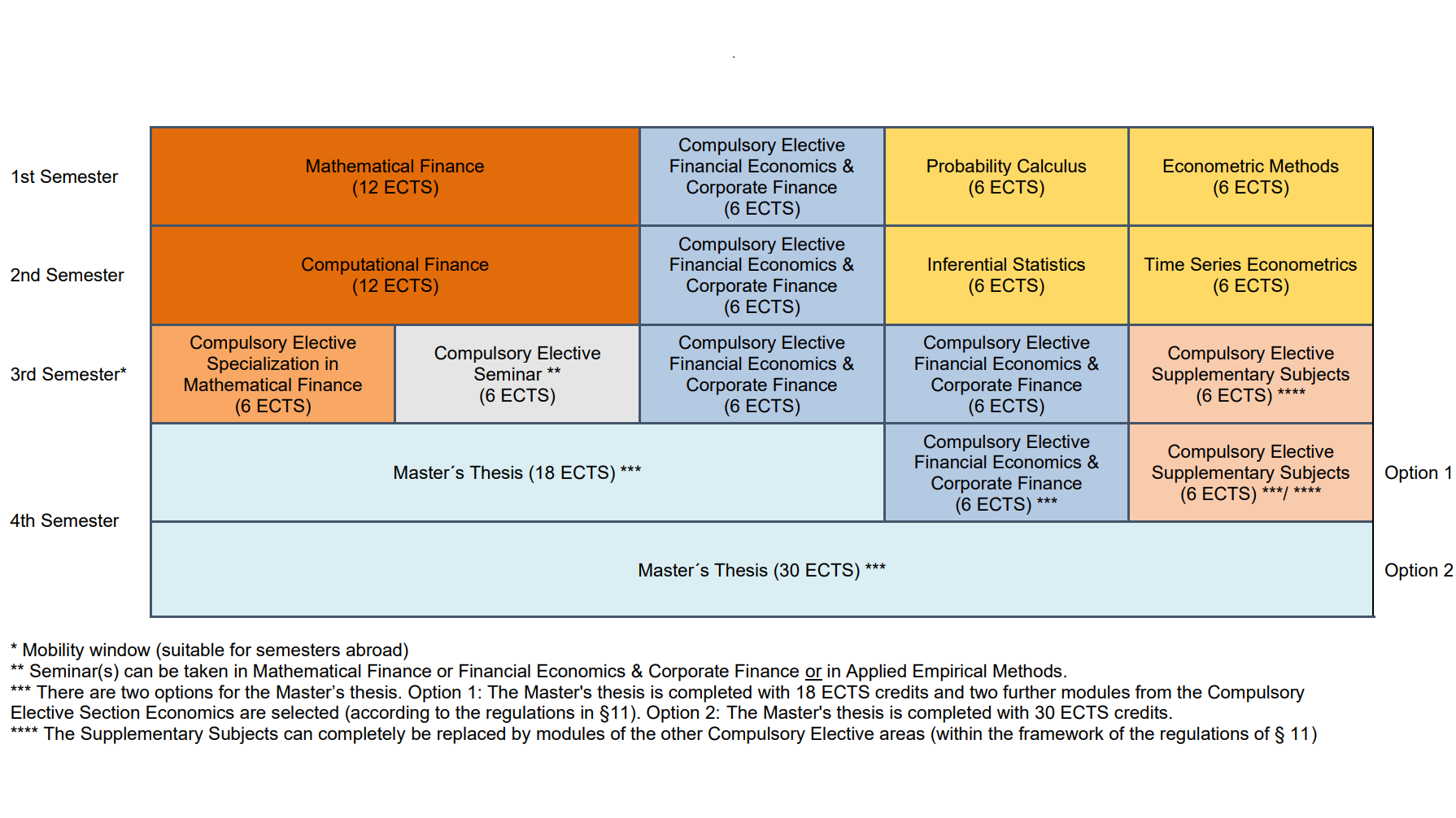
The Master's programme is organised in seven parts:

  1. Compulsory Section Statistics & Econometrics (24 ECTS)
  2. Compulsory Section Mathematical Finance (24 ECTS)
  3. Compulsory Elective Section Specialisation in Mathematical Finance (6 - 24 ECTS)
  4. Compulsory Elective Section Financial Economics & Corporate Finance (15 - 48 ECTS)
  5. Compulsory Elective Section Seminar (5 - 12 ECTS)
  6. Supplementary Subject (0 - 13 ECTS)
  7. Master's thesis (18 or 30 ECTS)

The regular length of study for the programme is four semesters. Core courses are comprised of lectures from the fields of financial economics, mathematical finance, econometrics and statistics. In addition to a Master's thesis, students have to write a seminar paper.

There are two versions for the completion of the Master's thesis:

  1. 30 ECTS: six months processing time, or
  2. 18 ECTS: 15 weeks processing time; two additional modules need to be completed

Documents:

A wide range of specialised courses offered on a regular basis gives students an insight into many areas of economic research arising through cooperation with the Kiel Institute for the World Economy.

Study plan:

A Diploma supplement will be issued
Yes
International elements
  • Language training provided
  • International guest lecturers
  • Integrated/optional study abroad unit(s)
  • International comparisons and thematic reference to the international context
Integrated/optional study abroad unit(s)

Kiel University and the Department of Economics offer exchange programmes for spending a semester at a partner university abroad (ERASMUS and direct partnerships with universities worldwide). For students interested in such exchange programmes, we recommend going abroad in the third semester of the programme. The credits from the partner university can be transferred to the programme.

Course-specific, integrated German language courses
No
Course-specific, integrated English language courses
No
Tuition fees per semester
None
Semester contribution

An enrolment fee ("Einschreibegebühr") of 55 EUR is charged for the first enrolment at Kiel University. A semester contribution ("Semesterbeitrag") currently amounting to 403 EUR must be paid each semester. This covers administration fees ("Verwaltungskostenbeitrag"), free public transport ("bundesweites Semesterticket") for trains and buses, reduced lunch prices, a culture ticket and other benefits for students.

Costs of living

The monthly costs of living in Germany are currently at least 992 EUR per month. Please note that when applying for a visa (from countries requiring a visa) and also later in Germany when extending a residence permit, financial means in the amount of the living costs for one year (11,904 EUR) must be proven.

More information can be found here: www.international.uni-kiel.de/en/incomings/planning-arrival-and-stay/visa.

Funding opportunities within the university
No
Academic admission requirements

Applicants are expected to hold a Bachelor's degree or a comparable university degree (minimum grade 2.5) with a regular period of university education of three years or more and 180 ECTS credit points or more.

In the 180 credit points, the following needs to be included:

  • 35 credit points from courses on principles of economics (i.e. courses on microeconomic theory and courses on macroeconomic theory) with no overlapping in substance, and in courses on quantitative methods with no overlapping in substance
    of which:
    • 20 credit points from courses on quantitative methods, i.e. courses on analysis, algebra, statistics and econometrics.

The programme also welcomes applications from students in fields such as mathematics, physics or computer science who have a proven interest in financial topics.

For an evaluation of the suitability of the course content, you have to submit an official module manual (containing the relevant syllabi) - either as a searchable pdf file or as a link to the university's website. In case no official module manual is provided by the university, module descriptions (syllabi) approved by the university are accepted. The module manual needs to be provided either in German or English.

Admission requirements can be found here.

Recommended Literature can be found here (pdf).

German language skills
No minimum language level required
English language skills
C1 required, please provide an official language certificate, e.g.:
  • UNIcert® English: UNIcert® III
  • TOEIC: 945
  • Reading: 455
  • Listening: 490
  • Speaking: 180
  • Writing: 180
  • TOEFL iBT (before 2026): 79
  • Reading: 24
  • Listening: 22
  • Speaking: 25
  • Writing: 24
  • IELTS Academic: 6.5
Language requirements exemptions
Please find details on the course website.
Online self-assessment

We provide an optional self-test for your own assessment of knowledge that is required in our Master's programmes.

Check here for more information.
Application periods

Application period with a Bachelor's degree obtained in other countries via uni-assist:

  • Winter semester: 1 April – 31 May
  • Summer semester: 1 October – 30 November

Application period with a Bachelor's degree obtained in Germany via Kiel University:

  • Winter semester: 1 June to 1 August
  • Summer semester: 1 December to 1 February
More information on application periods
Please find more details on this website.
Submit application via
Possibility of finding part-time employment

The Department of Economics and the Kiel Institute for the World Economy offer jobs as student assistants. Students can apply for these jobs upon availability.

Accommodation

Please find information on accommodation in Kiel on the following website: https://www.international.uni-kiel.de/en/incomings/planning-arrival-and-stay/accomodation.

Career advisory services and programmes for future professionals

Career counselling: https://www.careercenter.uni-kiel.de/en/career-counselling
Career Centre seminars: https://www.careercenter.uni-kiel.de/en/seminars

Support for international students and doctoral candidates
  • Welcome event
  • Tutors
  • Cultural and linguistic preparation
General services and support for international students and doctoral candidates

International students receive support by Kiel University's International Centre in manifold ways: www.international.uni-kiel.de/en/.

Kiel University

Content Bild
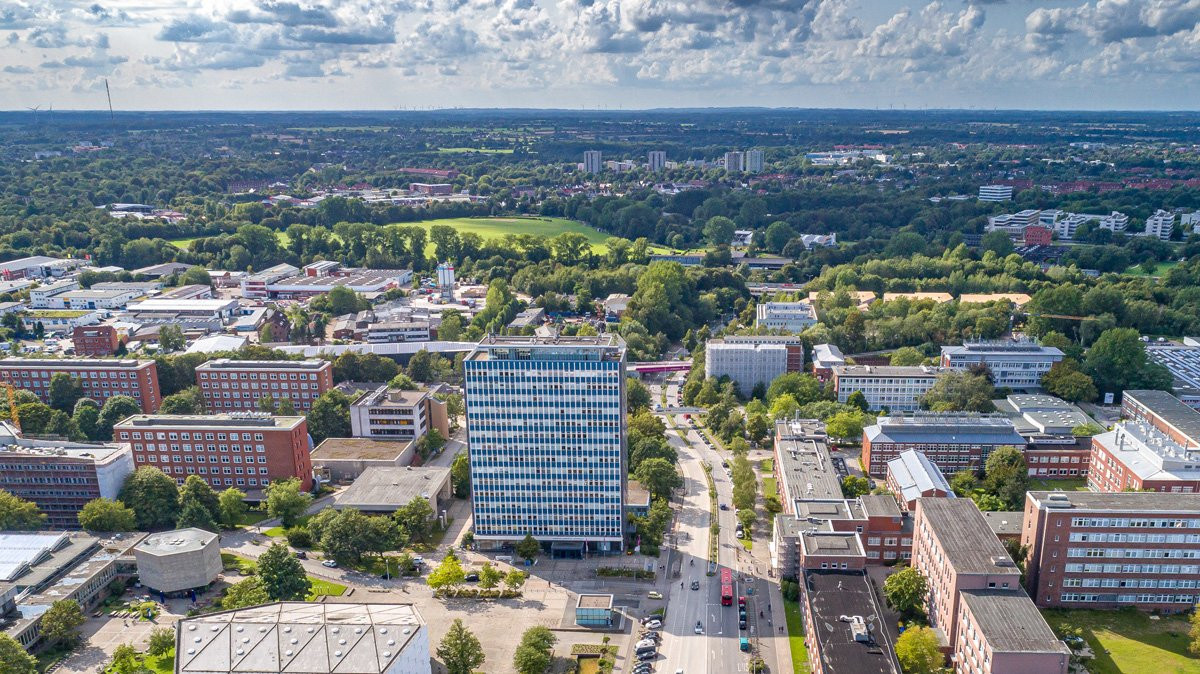
Kiel University © Marvin Radke – standbildtechniker.de

Kiel University (also referred to as the CAU) was founded in 1665. It is Schleswig-Holstein's oldest, largest and best-known university, with 27,000 students and 3,700 staff members. It is also the only full-fledged university in the state. Seven Nobel Prize winners have worked here. The CAU has been successfully taking part in the Excellence Initiative since 2006.

We use research, teaching and the transfer of science to address the great challenges of our time in health, environmental and cultural change, nutrition and energy. In doing so, we ensure peace and preserve livelihoods for future generations. We use responsible actions to make sure that scientific discoveries are transferred into all sectors of our society by interdisciplinary thought – regardless of short-lived trends – where they are incorporated into political, economic and social decisions aimed at securing peace and prosperity.

When it was founded back in 1665, the CAU had the motto “Pax Optima Rerum: peace is the most valuable asset.” This maxim is as applicable today as it was over 350 years ago. We want to follow this key idea and contribute towards creating a peaceful, fair world in which everyone lives freely and comfortably. We aim to create a world in which treating the environment with respect also enables future generations to enjoy the same benefits.

CAU’s mission:
Our mission is to deliver research and teaching that contribute to peace, prosperity and maintaining a pluralistic, free society as well as address the challenges we are facing. Our strong disciplines carry out this mission. The fulfilment of this mission requires interdisciplinary collaboration and involves transdisciplinary issues. We find solutions to today’s pressing problems and implement these solutions together with stakeholders from society, industry and politics.

Teaching profile:
We are dedicated to research-based teaching and learning. Therefore, the development of new teaching approaches is evolving constantly at the interfaces between research from the different scientific disciplines. Students from all over the world benefit from this: research results are quickly integrated into programme curricula and our academic staff is trained in state-of-the-art teaching methods.

Research profile:
The CAU is Schleswig-Holstein’s only full-fledged university with a major focus on research. Over time, four dynamic priority research areas have systematically developed. These are based on strong disciplines interacting together – Marine Science, Life Science, Societal and Cultural Change, and Nano Surface and Interface Science. Each individual research area makes a substantial contribution towards dealing with at least one of the grand challenges of our time.

Transfer profile:
A university is not an island. It is an entity that impacts on, with and for society in a number of ways, by offering space for new ideas, passing on knowledge and values, and enabling debates about controversial subjects. Universities train specialists, produce innovative products and start-ups, help companies to develop further and assist politics by giving advice and warnings. The CAU encompasses top quality, innovative science, a sense of responsibility and the transfer of knowledge. We advocate for the university’s active role in society and aim to work closely together with the community to be the driving force behind regional, national and international development by looking for and finding pioneering solutions for our most pressing issues. This is the reason why we maintain a variety of active connections with our partners in science, industry, politics and society.

Read more about our profiles.

27,000 Students
3,700 Staff members

University location

The city of Kiel is located directly on the Baltic Sea coast and is the capital of the northernmost German federal state, Schleswig-Holstein. Famous for its sailing tradition, Kiel has hosted two Olympic sailing competitions. The city's annual "Kiel Week" is the world's largest sailing event and one of the biggest cultural festivals in northern Europe. Kiel's international flair is enhanced by its port, where Scandinavian ferries dock next to cruise liners and historic ships. Those who enjoy going out will benefit from the city's lively cultural life as well as the many clubs and bars to be found between the campus and the city centre. Kiel is a strong centre of science and research. Our students benefit from studying by the sea in a city that offers short distances and a wide range of leisure facilities by the waterside. It takes less than 20 minutes to get from the lecture hall to the beach. A fresh breeze on your face and the right books on hand create a great atmosphere for learning. The social conditions for studying in Kiel are excellent. Freshmen receive a welcome payment of 100 EUR when they come to Kiel to commence their undergraduate studies. They have the opportunity to live in one of the many halls of residence, which are reasonably priced and situated close to the universities. In our bicycle-friendly city, not only the universities but also other inner-city locations can be reached conveniently by bike. The new scientific generation represents the most important resource for making Kiel, the state capital, fit for the future.

www.kiel.de

Activate map

To activate the map, click on the "Show map" button. We would like to point out that data will be transmitted to OpenStreetMap after activation. You can find out more in our privacy policy. You can revoke your consent to the transmission of data at any time.