English is the compulsory language of all modules and courses. There is the possibility for students with enough knowledge of the German language to attend compulsory optional subjects in German.
Non-EU applicants, winter semester – 30 May
Non-EU applicants, summer semester – 30 November
German & EU applicants, winter semester – 15 July
German & EU applicants, summer semester – 15 January
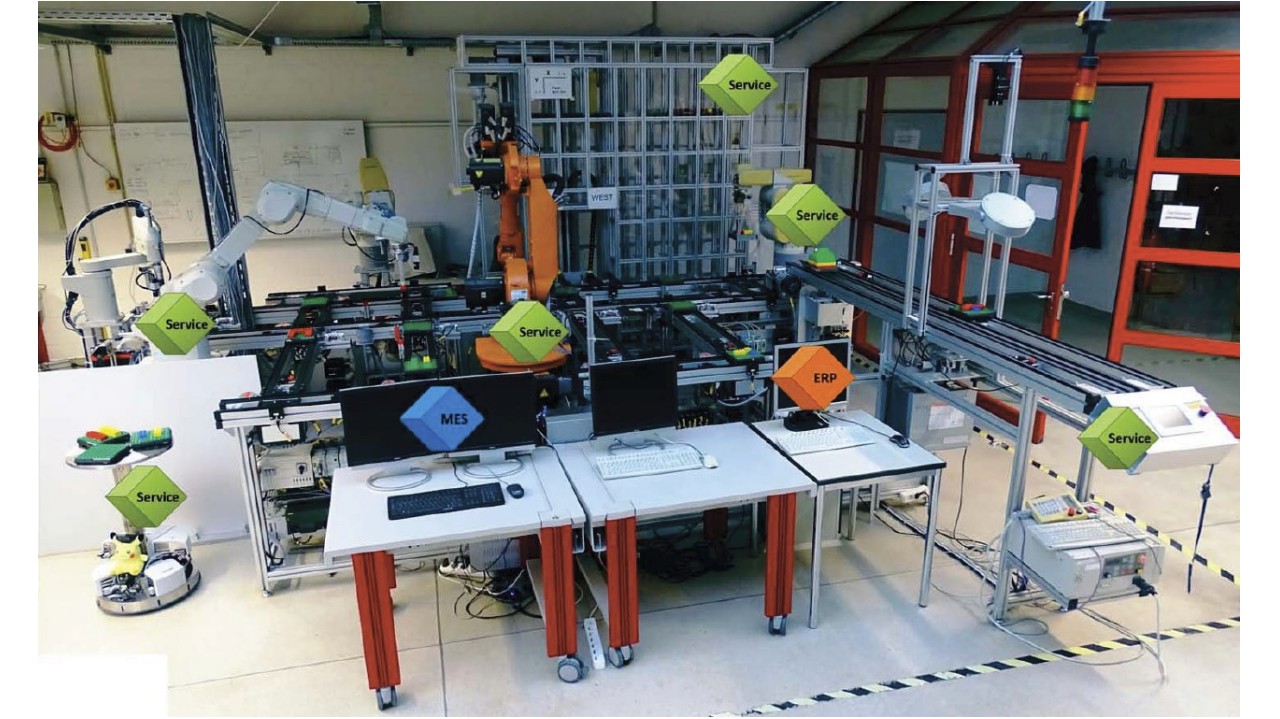
We are witnessing rapid changes in the industrial environment, mainly driven by business and societal needs towards production customisation and the digitalisation of the economy. In 2006, the term Cyber-Physical Systems (CPS) was coined to refer to the integration of computation with physical processes. CPS can be described as smart systems that encompass hardware and software as well as computational and physical components. These are seamlessly integrated, closely interacting to sense and to control the changing state of the real world in real time. These systems involve a high degree of complexity at numerous spatial and temporal scales, and highly networked communications integrating their computational and physical components. As such, CPS refers to Information-Communication-Control-Mechatronics Systems (sensing, actuating, computing, communicating, etc.) embedded in physical objects, interconnected through several networks including the internet, and providing citizens and businesses with a wide range of innovative applications based on digitalised data, information, and services.
Ontologically, the term Cyber-Physical Systems means hardware-software systems that tightly couple the physical world and the digitalised (virtual) world. In a CPS ecosystem, on the one hand every real physical object (things/assets) has one or more cyber representations, and on the other hand a cyber component or system can be linked to a physical representation, i.e. an object in the three-dimensional human-tangible world. Moreover, these things are increasingly interconnected in real-operational time, either permanently networked or communicating in an asynchronous manner from time to time, using the Internet (Internet-of-Things, IoT). Digitalised data and information associated to functions of these things are then exposed as services in the Internet (Internet-of-Service, IoS) and they can be consumed by any other CPS for performing business.
Industrial Cyber-Physical Systems (ICPS) forge the core of real-world networked industrial infrastructures that have a cyber representation through digitalisation of data and information across the enterprise, along the product and process engineering life cycle, and from suppliers to customers along the supply chain. As such, the competitive performance of an ICPS mainly depends on the ability to effectively collect, analyse, and use large-scale digitalised data and information from many different and often heterogeneous sources in order to sustainably and efficiently manage, supervise, and operate in the industrial environments. This effective information-driven interaction of ICPS with other real-time critical CPS like IT-enterprise systems, extending to all business processes, is viewed as vital to modern industries.
There are many challenges ahead in the convergence of computing, control, mechatronics, communications and software programming for CPS ecosystems. There is a need for investigating and learning a wide spectrum of foundations, research, and technological fields. In this context, the Master in Industrial Informatics with a specialisation in ICPS addresses the penetration and proliferation of such ecosystems in the industrial environments, taking into account that the same trend is also evident in other domains such as energy, healthcare, manufacturing, military, transportation, consumer, enterprise, robotics, and smart cities, among others.
There is an obligation to submit a health insurance declaration: since 1 December 2021, the University of Applied Sciences Emden/Leer has been using the electronic student notification procedure (SMV). Notifications from the health insurance companies can only be accepted electronically. In addition to the application, all applicants must apply for a confirmation of insurance from a statutory health insurance company, quoting our sender number H0002194.