Most courses are held in English. German skills are not necessary for the application, but they are strongly recommended in order to ensure a successful transition into working life.
Full-time / part-time
full-time
Programme duration
4 semesters
Beginning
Winter semester
Application periods
The application period for international students is from 1 February to 31 May of each year.
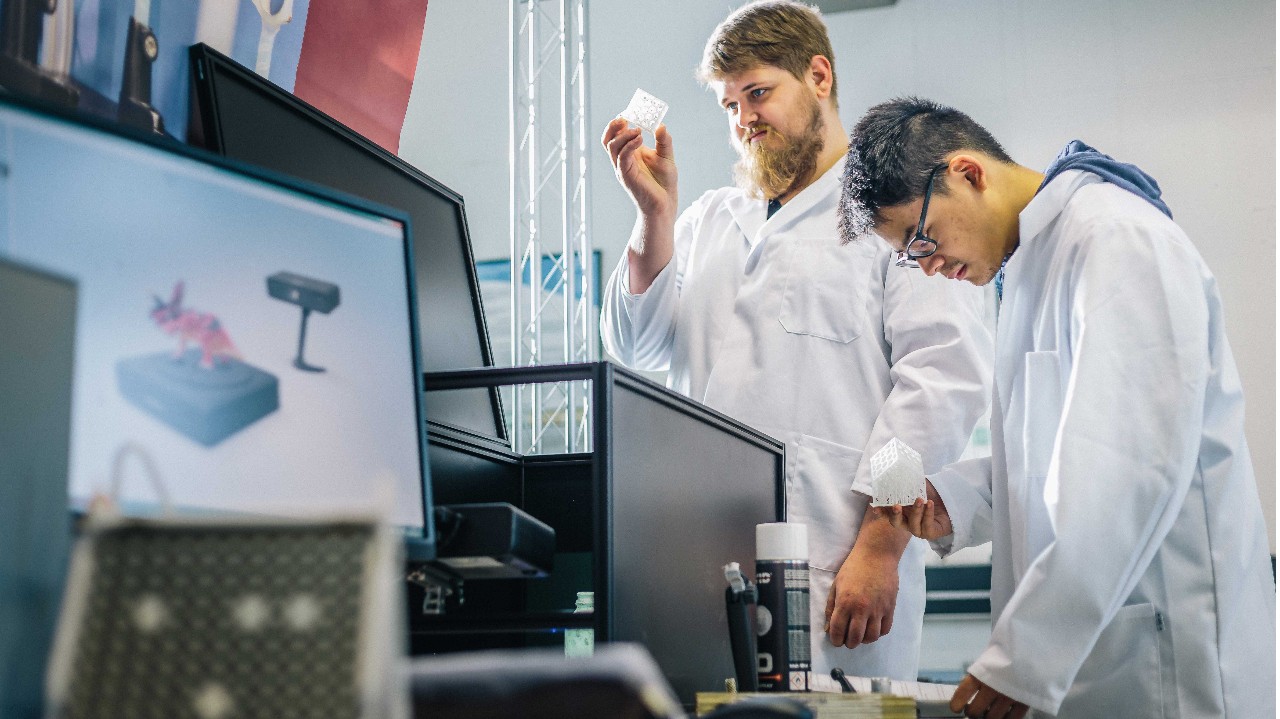
The four-semester Master's degree course of study (held in English) provides a specialisation in Materials Science and Engineering. In general, the courses are held in the form of lectures accompanied by seminars and labs. It covers advanced chemical, physical and mechanical aspects of modern materials sciences and offers a solid basis for deepening both the scientific knowledge and its practical application.
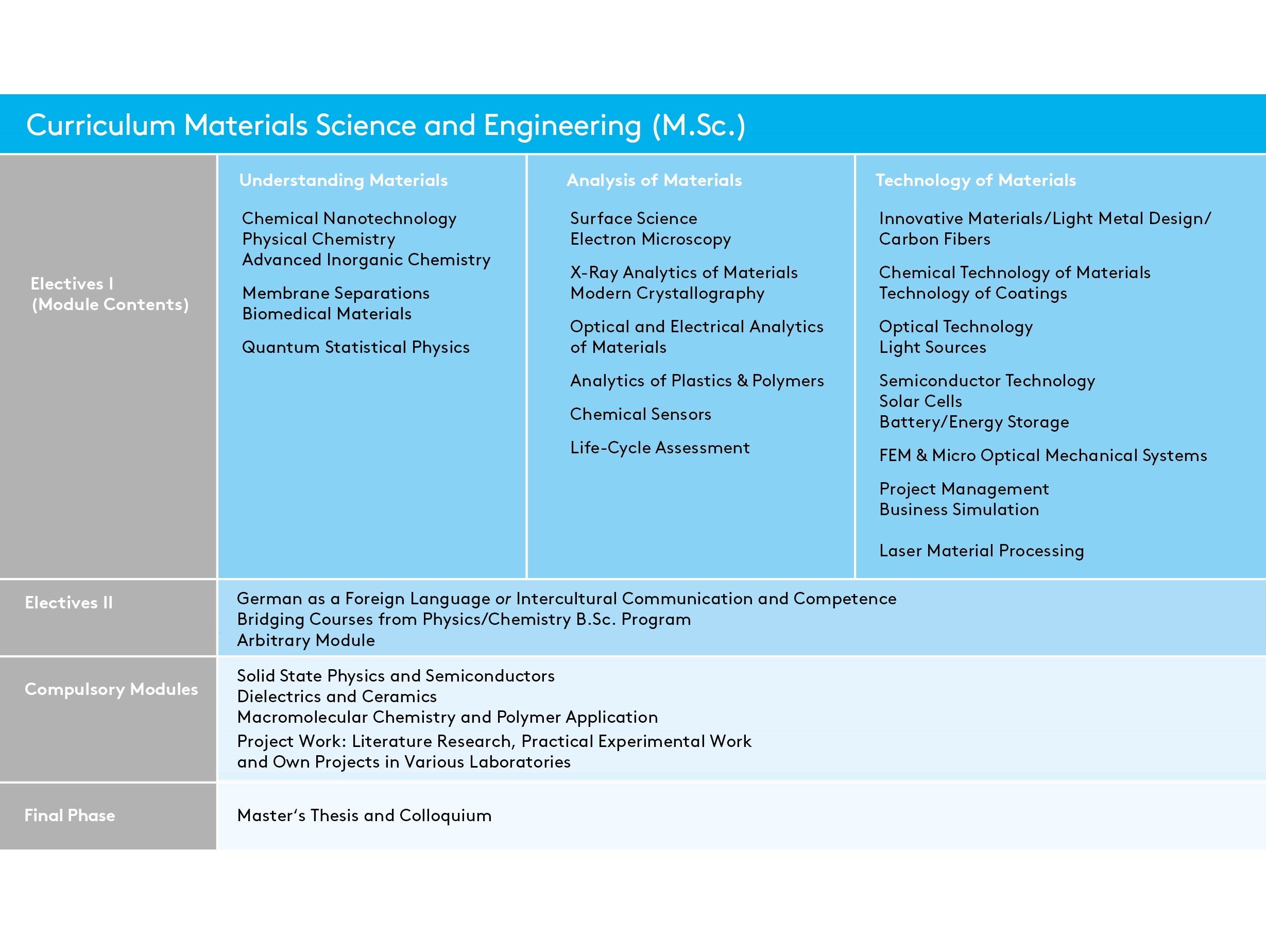
The first three semesters of study will cover core subjects including Solid State Physics, Dielectrics and Ceramics, as well as Macromolecular Chemistry and Polymer Applications. These modules are mandatory. In addition, students will have to complete a research project in each of the three semesters. The final semester is reserved for the preparation of the Master's thesis, which can be completed in collaboration with research institutes or industrial partners. This course of study prepares for a career in research and development or for a PhD programme.
For further information, please contact the Department of Chemical Engineering or Engineering Physics.
Course organisation
There are three compulsory modules: Solid State Physics and Semiconductors, Dielectrics and Ceramics, Macromolecular Chemistry and Polymer Application. Three research projects shall be completed.
Examples of elective modules in Chemistry:
Particle Technology, Technology of Coatings, Incoherent Light Sources, Life-Cycle Assessment, Advanced Physical Chemistry, Membrane Separations, Advanced Inorganic Chemistry, Chemical Technology of Materials, Analytics of Plastics and Polymers, Optical and Electrical Characterisation of Materials, Chemical Sensors, Aerosol- and Nanotechnology.
Examples of elective modules in Physics:
Quantum Statistical Physics, Biomedical Materials, Microscopy/Surface Science, Integrated Devices, Battery Production, Laserphysics, Laser Materials Processing, Quantum Sensors, Modelling and Simulation, Image Processing, Modelling and Simulation, Optical Coherence Tomography, Photonic Crystals and Materials.
Examples of elective modules in Mechanical Engineering:
Innovative Materials
Examples of elective modules in Business Administration:
Project Management, Management Skills
Further elective courses can be chosen with a maximum of 12 credit points in total. Examples of additional modules: Basics in Physics or Chemistry for engineers, German as a Foreign Language (compulsory for international students), Intercultural Communication and Competence
The last semester is designed for the Master's thesis, typically performed in research and development departments in industrial companies and the final defence (30 credit points). In total, 120 credit points are necessary for graduation.
Career advisory services and programmes for future professionals
From enrolment to graduation: The "INTERNATIONAL TALENT JOURNEY" (ITJ) supports international students on their way through their studies at FH Münster. We offer many activities for every phase of your studies to increase your academic success and facilitate your transition into the job market.
Support for international students and doctoral candidates
Buddy programme
FH Münster University of Applied Sciences
FH Münster - University of Applied Sciences has a long tradition of education. Founded in 1971 following a merger of public and private schools of engineering and vocational training institutions, it is now one of Germany's largest and most successful institutions of its kind. The aim of FH Münster is to be the top address for practical education and research. Quality pervades all areas within the university and is the foundation upon which we build our excellent successes in teaching and research – we have the highest rate of third-party funding of any German university of applied sciences. It is the quality that inspires companies to enter into strategic alliances and partnerships with the university. All of these attributes characterise the image of this modern, high-performing, and student-oriented university.
University location
FH Münster – University of Applied Sciences, with approx. 15,000 students and 13 departments / central research institutions, is located in Münster and in Steinfurt. Münster, the Westphalian city with around 320,000 inhabitants, is the ideal place to study, offering a wide range of leisure activities for more than 60,000 students enrolled at Münster's eight higher education institutions. In addition to many pubs, bistros, and bars, Münster also has numerous museums, theatres, and cinemas. A local recreation area around the Aasee is ideal for jogging and walking. Münster was the first city of its size to be awarded the title of the World's Most Liveable City and is regularly voted the bicycle capital of Germany. The following departments of FH Münster are located in Münster: the Münster School of Architecture, the Department of Civil Engineering, the Münster School of Design, the Department of Food – Nutrition – Facilities, the Münster Department of Health, the Department of Social Work, the Münster School of Business, and the Münster School of Vocational Education (IBL).
Around 5,000 students study at the Technology Campus Steinfurt. Embedded in Münsterland's park landscape, the tranquil district town of around 36,000 inhabitants presents itself as a business location with many medium-sized enterprises. The town also has lots of restaurants and pubs. Trains go from Burgsteinfurt station to Münster every hour. The journey takes around 40 minutes. The following departments of FH Münster are located in Steinfurt: the Department of Chemical Engineering, the Department of Electrical Engineering and Computer Science, the Department of Mechanical Engineering, Energy – Building Services – Environmental Engineering, the Department of Engineering Physics, and the Institute of Business Administration & Engineering.
Activate map
To activate the map, click on the "Show map" button. We would like to point out that data will be transmitted to OpenStreetMap after activation. You can find out more in our privacy policy. You can revoke your consent to the transmission of data at any time.
We need your help to improve our website!
Dear students and all interested parties,
we are re-designing our website and want to include you in the process.
Please fill out a short questionnaire. This will only take a few minutes,
but will help us tremendously to determine how we can improve the usability of our website.
Thank you very much for your support!