The targeted development of new materials (materials design) and the manufacture of components/construction elements with the desired properties require a combination of academically motivated and application-oriented research that deals with the description of functional relationships. That is why scientists with in-depth knowledge of instrumental solid-state analysis and semiconductor technology are in constant demand in academia and industry.
The Master's programme in Advanced Materials Analysis is aimed at graduates of Bachelor's programmes in physics, materials science, electrical engineering or chemistry who wish to deepen their education in the use of instrumented materials analysis methods, physical measurement methods and/or semiconductor technology.
Course organisation
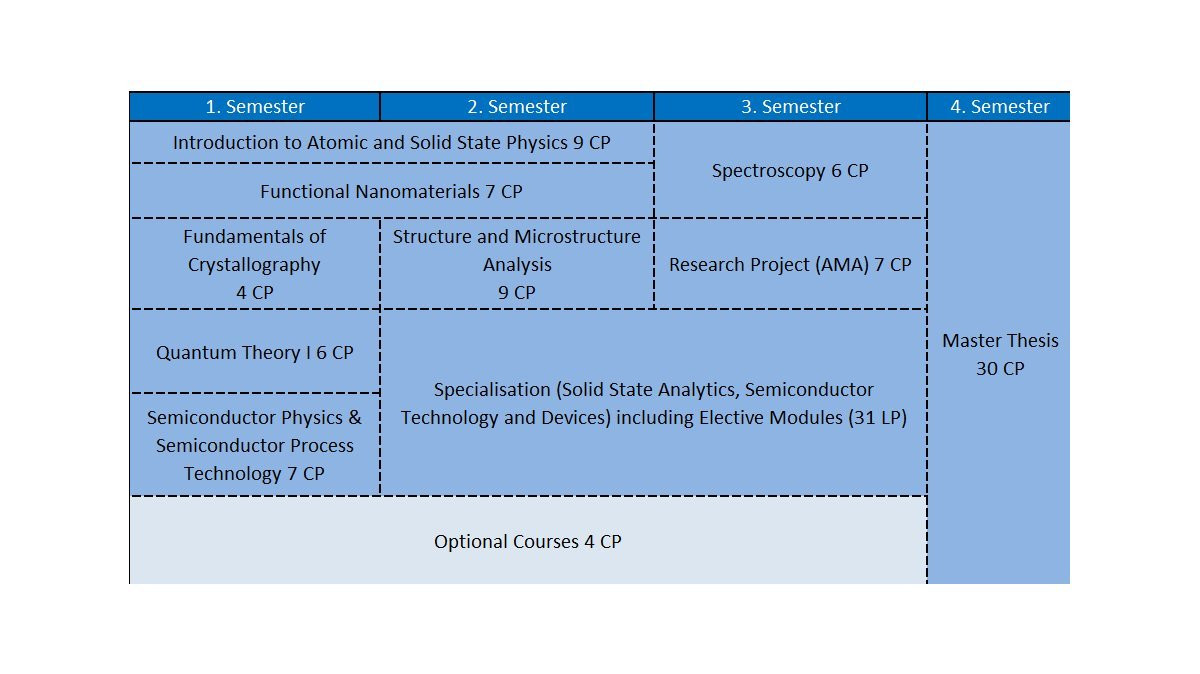
A minimum of four semesters (two years) is required to complete the AMA Master's programme.
After the first semester, students have to choose one of these specialisations:
A) Solid-State Analytics
The specialisation in Solid-State Analytics focuses on the structural and microstructural analysis of mainly inorganic materials (semiconductors, ceramics, metals and their alloys) for electronics, sensor technology, optical applications and energy systems. The most important analytical methods include electron microscopy, spectroscopic methods and diffraction methods. A unique feature of the programme are courses on synchrotron sources and free-electron lasers and their use in in situ analyses of fast processes in modern materials.
B) Semiconductor Technology and Devices
The specialisation Semiconductor Technology and Devices focuses on imparting knowledge of semiconductor process technology, i.e. how semiconductors are processed in order to manufacture components. On the other hand, it teaches the physical functioning of various components from the fields of electronics, optoelectronics and photovoltaics in theory, simulation and practice. Furthermore, it introduces the electrical, optical and structural measurement methods that can be used to investigate the structure-property relationships, for example in relation to atomic point defects and their influence on component behaviour.
During the third semester, a research project is being carried out alongside other modules in the specialisation.
In the fourth semester, students write their Master’s thesis.
Course-specific, integrated German language courses
Yes
Course-specific, integrated English language courses
No
Tuition fees per semester
None
Semester contribution
107 EUR
Costs of living
650 EUR to 950 EUR per month, depending on individual lifestyle
Rent in a student hall of residence per month: an average of 290 EUR
Funding opportunities within the university
Yes
Description of the above-mentioned funding opportunities within the university
The "Deutschlandstipendium" is a national scholarship programme that supports above-average students with excellent grades. Social commitment, a willingness to take responsibility and special social, family or personal circumstances will also be taken into account (300 EUR per month for one year).
Study completion grant (300 EUR per month for three months)
Academic admission requirements
Bachelor's degree (at least six semesters) or an equivalent degree in materials science, physics, chemistry, electrical engineering or engineering with a focus on materials science, which should include topics from the field of solid-state physics or solid-state chemistry. (Please note: Applicants with a degree in Mechanical Engineering must have taken any of the above-listed majors to be admitted.)
Qualification assessment procedure (including online test in mathematics and physics)
Candidate Profile: AMA is open for students to upgrade their knowledge in materials science, engineering science or in the fields of natural science specialised in physics or chemistry. The candidate should be interested in the composition, properties and analysis of solid materials down to the atomic level, combining the natural scientist's and engineer's perspective.
German language skills
No minimum language level required
English language skills
B2 required, please provide an official language certificate, e.g.:
TOEFL iBT (before 2026): 90
Reading: 23
Listening: 23
Speaking: 22
Writing: 22
Application periods
The following is valid for applicants from:
all countries
For the winter semester:
1 January - 15 April
Part-time employment on campus (e.g. student assistant, canteen) as well as in town (e.g. in supermarkets, cafés, restaurants)
Accommodation
Different kinds of accommodation are available on campus and in the city of Freiberg. The average monthly rent for a room in the student halls of residence, including utilities, is 290 EUR. The most common form of accommodation is the shared flat. Each student has their own room, with the bathroom and kitchen shared.
A separate online application is required to apply for accommodation in the student halls of residence. The recommended time to submit this is three months before the start of the semester.
Career advisory services and programmes for future professionals
Counselling: development of personal and skills profiles, individual application portfolio checks, preparation for job interviews
Training in technical and leadership skills: soft skills training, development of interdisciplinary knowledge, coaching for job applications / career entry
To activate the map, click on the "Show map" button. We would like to point out that data will be transmitted to OpenStreetMap after activation. You can find out more in our privacy policy. You can revoke your consent to the transmission of data at any time.
We need your help to improve our website!
Dear students and all interested parties,
we are re-designing our website and want to include you in the process.
Please fill out a short questionnaire. This will only take a few minutes,
but will help us tremendously to determine how we can improve the usability of our website.
Thank you very much for your support!