International Programmes 2025/2026

Global Communication: Politics and Society Global Communication: Politics and Society

University of Erfurt • Erfurt

Degree
Master of Arts
Course location
Erfurt
Teaching language
  • English
Languages

The curriculum will be taught in English. Therefore, very good English proficiency is required in order to successfully follow the programme. We recommend that students from abroad who are unable to speak German study German before and during their studies. Extracurricular language courses are offered by the Language Centre at the University of Erfurt.

Programme duration
4 semesters
Beginning
Winter semester
Application deadline

The application period for the following winter semester starts on 1 January and ends on 15 July. Applications will be continually processed during this period.

Based on many years of experience, we recommend early application! With an early application, it is still possible to start your studies on time in October, despite longer visa processes. For better orientation, we have compiled an overview of ideal application times on our website.

Tuition fees per semester in EUR
None
Combined Master's degree / PhD programme
No
Joint degree / double degree programme
No
Description/content

The Master’s programme in Global Communication: Politics and Society is a consecutive degree programme conducted in the English language. It deals with media systems and communication cultures in international comparisons.

The Master's programme is innovative in that it does not discuss classical questions of communication studies from an isolated national lens but deals specifically with "global communication" in the sense of international comparisons. In the courses, special emphasis is placed on the equal inclusion of the Global North and South as well as communicative interactions. In addition, processes of international cross-border communication, foreign reporting and the globalisation of everyday lifeworlds are addressed. As a result, sensitivity for the common communicative challenges of the world is growing.

Exemplary issues and fields of application:

  • the role of media in democracies, political transitions, wars, and conflicts in different regions of the world (i.e. foreign reporting, war and crisis communication) 
  • the interplay between media and globalisation (i.e. information society, global entertainment culture, global public sphere)
  • media developments in Asia, Africa, Middle East, and Latin America
  • migration and the public sphere (i.e. hate speech, racism, intercultural communication)
  • globalisation and communication in everyday life (i.e. communication and tourism)
  • communication in Islamic-Western relations (i.e. media and stereotypes, diplomacy communication, terrorism as a communication strategy)
  • global business communication (i.e. corporation networks and culture) 
  • contemporary changes in media production and usage in international comparison (i.e. journalism and ethics in global perspective, disinformation)

While the programme is primarily oriented towards the social sciences, it also takes approaches from the field of cultural studies into account. Besides developing academic research skills and learning quantitative and qualitative empirical methods, students will acquire knowledge of academic communication consultancy in dedicated teaching units. 

The Master's programme in Global Communication: Politics and Society prepares students to work in the professional fields of academic or commercial social research, market analysis, and media research. Moreover, students will be qualified to work in various professions in the fields of journalism, public relations, and academic communication consultancy for politics and society, for example, in government bodies, foundations, and NGOs. Due to the research-oriented specialisation, students may also choose to pursue an academic career. For this purpose, the programme provides an optional “fast track” programme for PhD students. Owing to the focus on global comparative research perspectives and consultancy skills in international contexts, the programme opens up further professional fields at home and abroad.

Course organisation

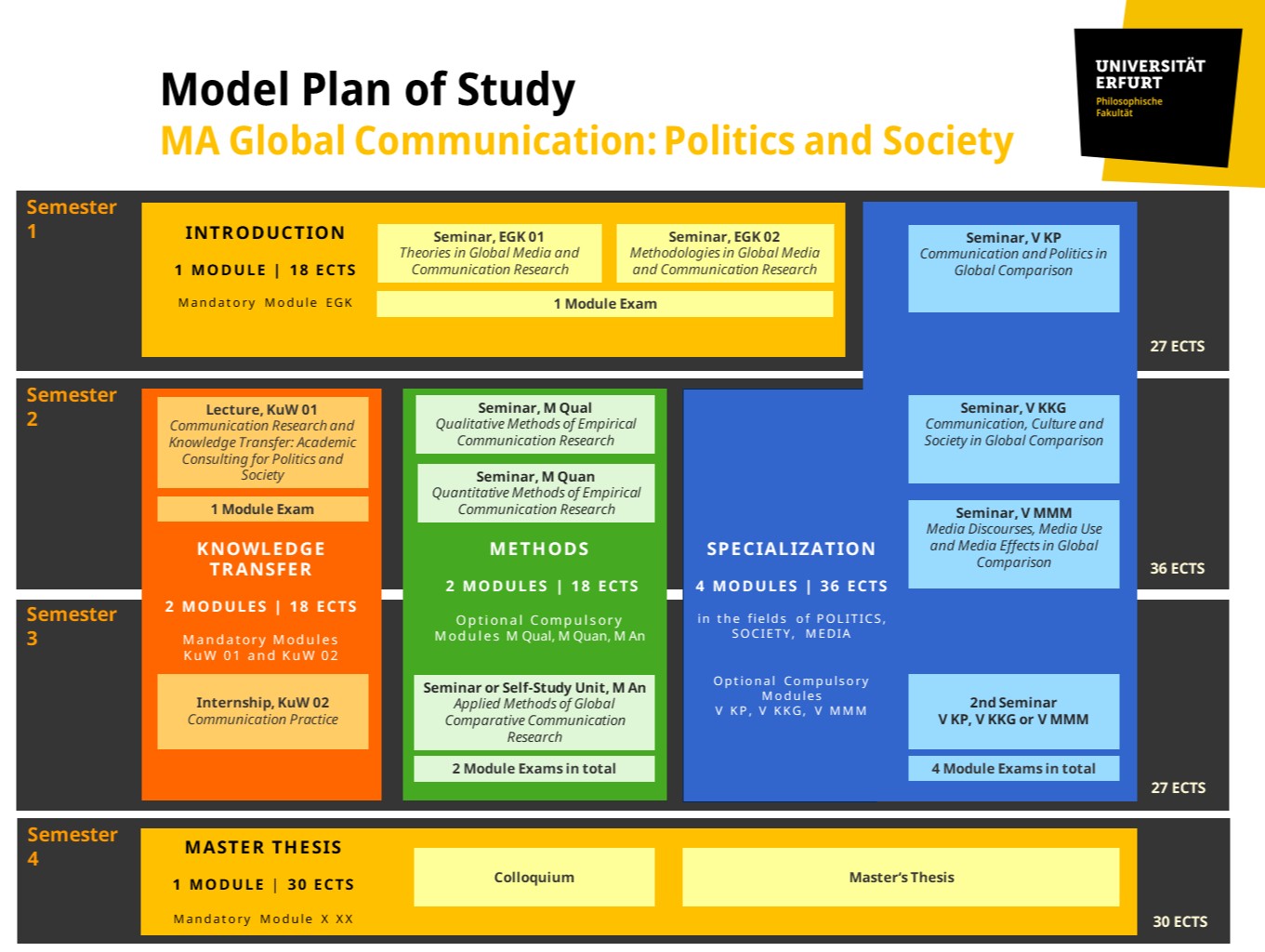
The Master's programme in Global Communication: Politics and Society consists of one mandatory introductory module in the first semester that covers both the theories and methods of global comparative media and communication research.

  • During their first three semesters, students choose four optional compulsory modules in the fields of a) politics, b) society, and c) media. 
  • In the second and third semester, students also chose two optional modules in empirical methods as well as two accompanying knowledge transfer modules that introduce communication consultancy for politics and society and include an internship at home or abroad. 
  • The fourth semester will be devoted to the Master’s thesis, which will be presented in a colloquium.
A Diploma supplement will be issued
Yes
International elements
  • International comparisons and thematic reference to the international context
  • Content-related regional focus
  • Projects with partners in Germany and abroad
  • International guest lecturers
Diverse intercultural background of students
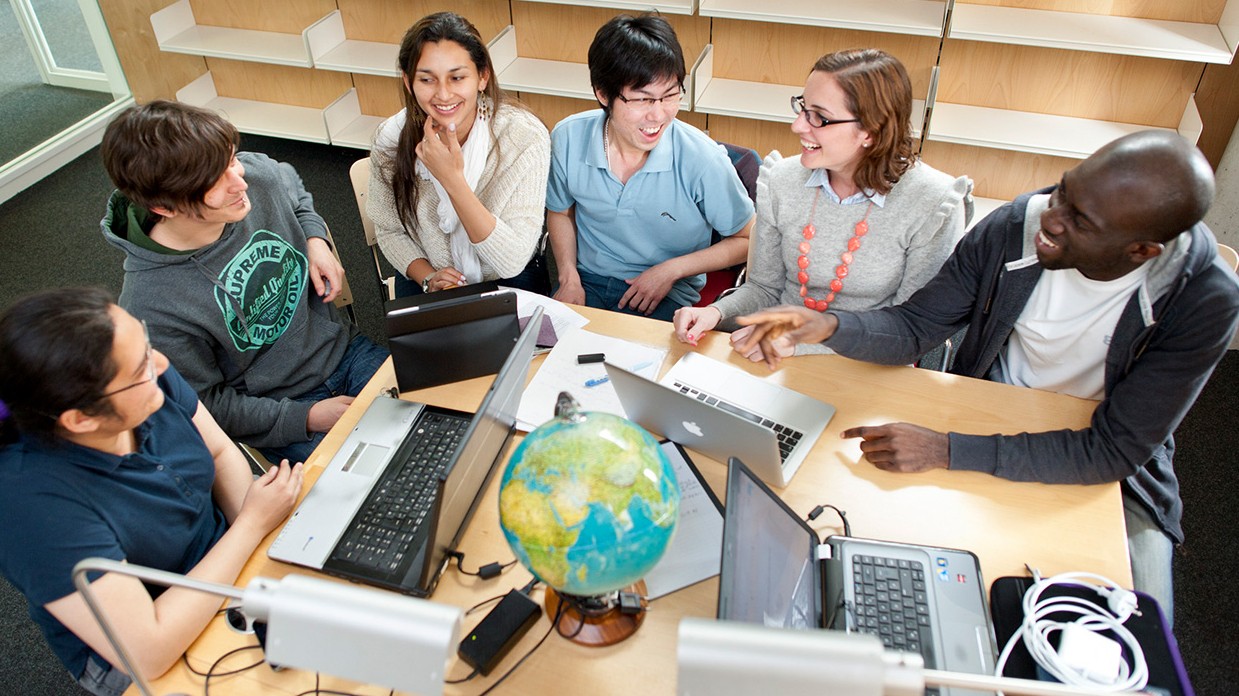
The student body is very international and diverse and integrates students from Germany, EU and non-EU countries (both from the Global North and South).
Integrated internships

The programme includes an internship in an internationally orientated political, commercial, or civic institution or organisation. The internship provides students with the opportunity to learn and apply academic communication consultancy skills in practice. The search for appropriate internship positions will be supported by programme staff.

Course-specific, integrated German language courses
No
Course-specific, integrated English language courses
No
Tuition fees per semester in EUR
None
Semester contribution

The semester contribution (approx. 300 EUR per semester) currently includes the "Deutschlandsemesterticket" (Germany Semester Ticket), which enables travel free of charge through Germany on all local public transport (not valid in ICE, IC/EC).

Costs of living

Authorities estimate that living costs of students in Germany are currently 843 EUR per month (as of 2023). International students who have to apply for a visa must provide relevant proof to the authorities that 992 EUR are available each month for the entire stay in Germany. The DAAD website provides further detailed information on finances.

Funding opportunities within the university
No
Academic admission requirements

The prerequisite for admission to the programme is a relevant Bachelor's degree in the area of media and communication studies or journalism studies. If students have another related social science degree, proof of basic knowledge of media and communication theories and subjects is required. Furthermore, prior knowledge of empirical methods is necessary (12 ECTS). Admission to study in the programme requires the successful participation in the selection procedure, which includes a personal interview. Detailed information about the application process can be found on the programme website.

Language requirements

Very good English proficiency is required:

  • TOEFL iBT: 80 or above
  • IELTS 6.5 or above
  • C1 (CEFR)

Equally accepted standards are:

  • a Bachelor's degree in an English language programme or
  • six months of English language higher education experience in an English-speaking country.
Application deadline

The application period for the following winter semester starts on 1 January and ends on 15 July. Applications will be continually processed during this period.

Based on many years of experience, we recommend early application! With an early application, it is still possible to start your studies on time in October, despite longer visa processes. For better orientation, we have compiled an overview of ideal application times on our website.

Submit application to

Applications are submitted online via the application portal.

Possibility of finding part-time employment

International students who are staying in Erfurt for at least two semesters are legally allowed to work up to 120 full days or 240 half days per year, mainly during the semester break. The authorisation is provided directly by the Foreigners' Registration Authority, so you do not need a work permit from the job centre. If you have received a scholarship for your studies and want to earn extra money during your stay in Erfurt, you will need permission from the body providing you with the scholarship. You do not need permission for a job as a student assistant at the university.

It is not easy to find part-time jobs in Germany. However, with good language skills, particularly in German and English, and a little bit of luck, you could find a temporary job typing or doing auxiliary work for companies or a part-time job in a call centre, factory or bar.

Please also see the information about daily life in Erfurt provided by the International Office at the University of Erfurt.

Accommodation
  1. Student Residence: This is the classic choice of the student housing options. Student residences are usually run by the Student Services Organisation. The rooms are often partially furnished but vary from residence to residence.
  2. You can also look for a room in a shared flat on your own. Quite a few German degree-seeking students partake in exchange programmes for a semester or two and offer their rooms for sublet.
Support for international students and doctoral candidates
  • Welcome event
  • Buddy programme
  • Tutors
General services and support for international students and doctoral candidates

Individual consultation will be offered on a regular basis.


University of Erfurt

Content Bild
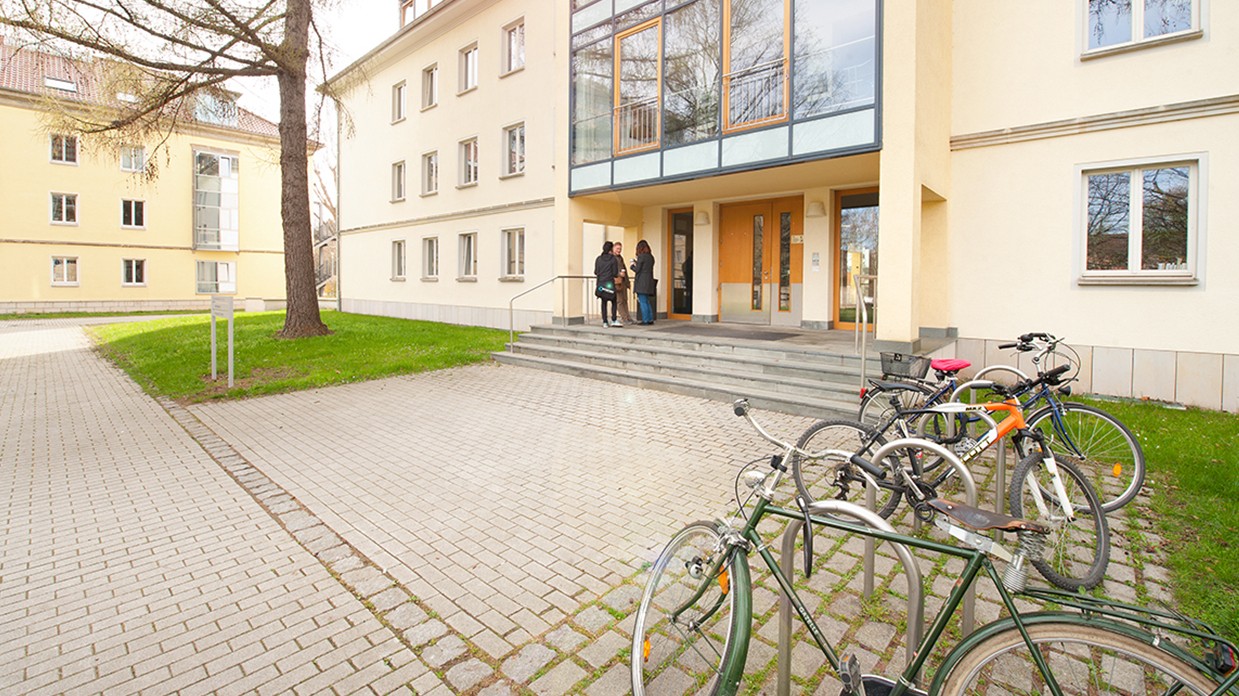
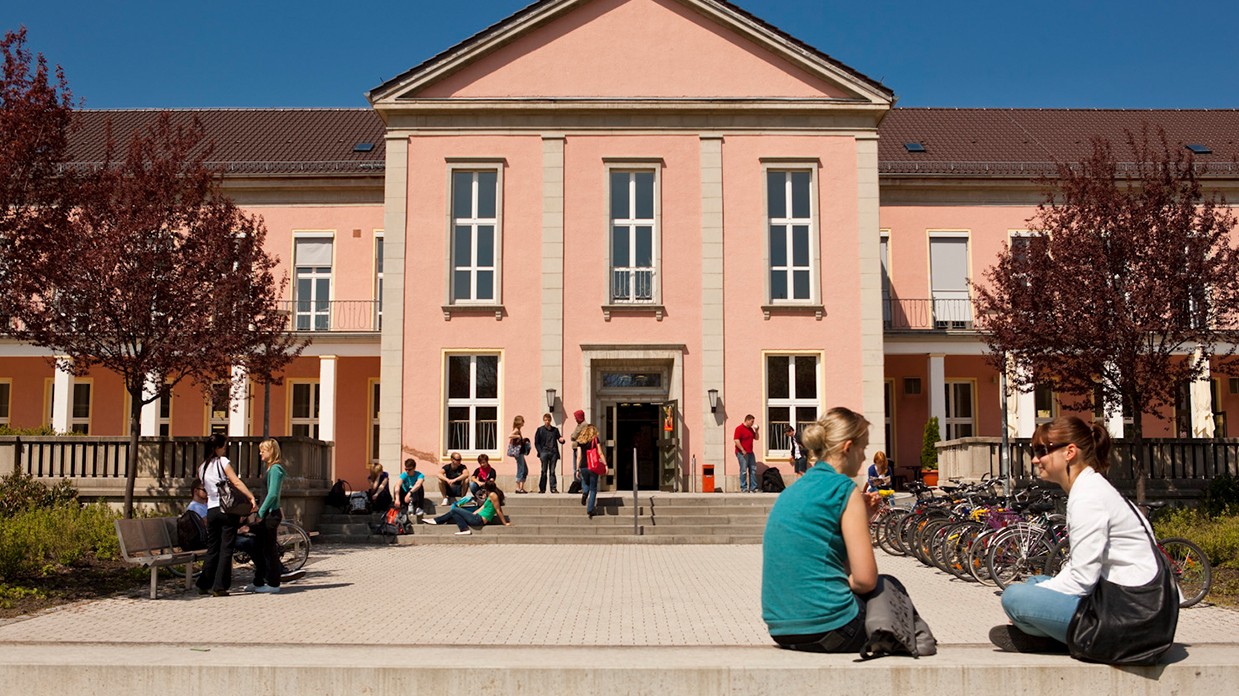
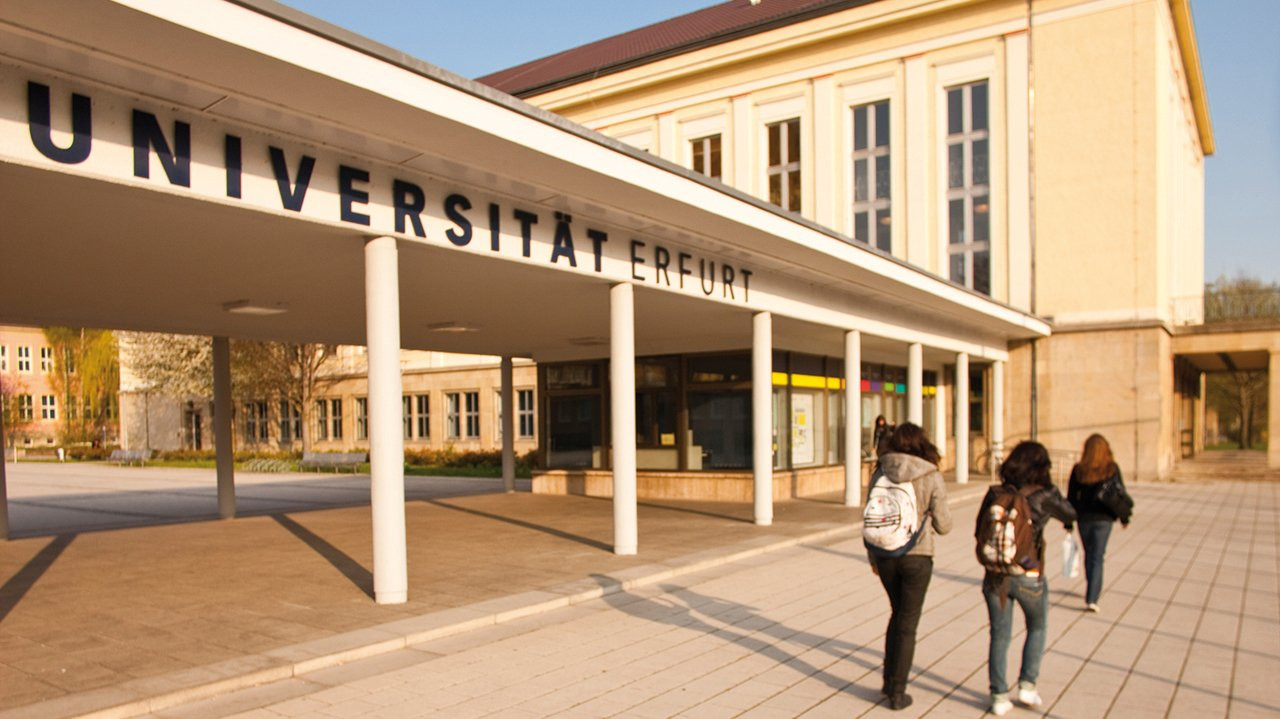
Entrance of the University of Erfurt © University of Erfurt

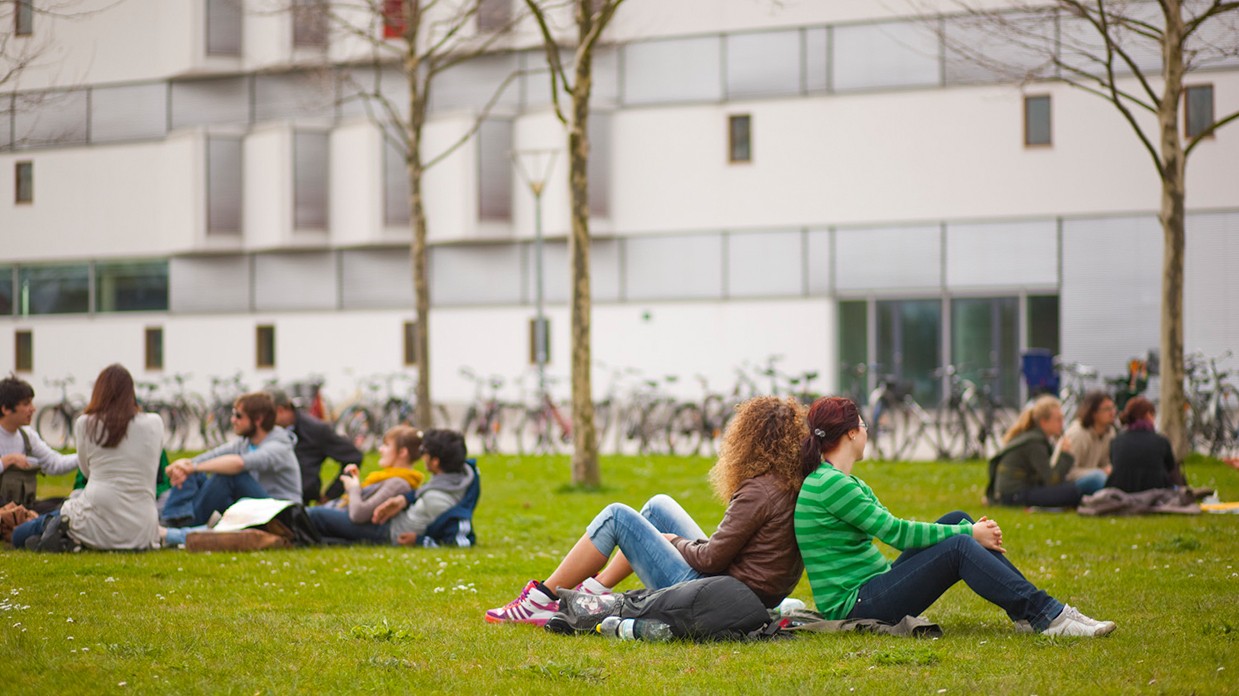
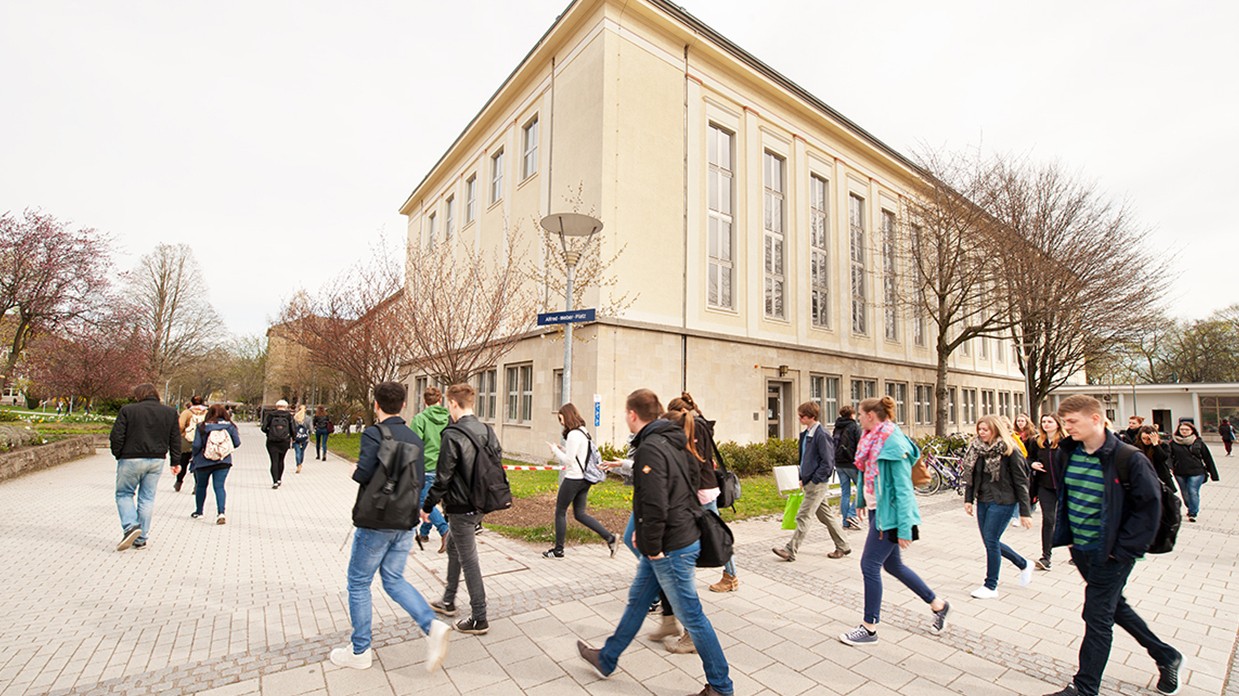
The University of Erfurt is a campus university with more than 100 chairs and nearly 6,000 students. The reform university for the arts and humanities with a particular focus on cultural and social sciences offers an inspiring atmosphere for studying and conducting academic work. The close ties among the four faculties of Philosophy; Education; Economics, Law and Social Sciences; and Catholic Theology. The Max Weber Centre for Advanced Cultural and Social Studies helps the university as a whole forge new paths in teaching and research.

Today, the University of Erfurt sets standards in basic research, and at the same time, it strives to transfer its scientific findings to society. In doing so, the four faculties (Faculty of Philosophy; Faculty of Education; Faculty of Economics, Law and Social Sciences; and Faculty of Catholic Theology), the Max Weber Centre for Advanced Cultural and Social Studies, and the Gotha Research Institutes contribute their structural and task-related diversity to the overall concept, thus enabling interdisciplinary, international, and cooperative research.

Against this background, the University of Erfurt also attaches particular importance to academic freedom and the promotion of young researchers. The attractive and in part unusual profile of the University of Erfurt is also reflected in its research activities within the three main areas of focus: "Education, School, and Behaviour"; "Religion, Society, and World Relations"; and "Knowledge, Spaces, and Media".

In the sense of the "Erfurter Modell" (Erfurt model), the university will continue to highlight its role as a uniquely profile-oriented institution in the future, thereby enhancing its attractiveness and distinct recognisability. In addition to emphasising its position as an innovative reform university, it will also expand its original concept of internationality towards interculturality and cultural diversity as part of the broader Erfurt model mission.

University location

The City of Erfurt
A whole host of unique characteristics make Erfurt what it is. One of the oldest cities in Central Germany, it looks back on a long history spanning more than 1,250 eventful years. Its fortunate location at the crossroads of many European trading routes allowed the city grow into an economical, political, cultural and intellectual hub at a very early stage. Many important figures helped to write the history of Erfurt: Martin Luther, Ulrich von Hutten, Adam Ries, Johann Wolfgang von Goethe, Friedrich Schiller and Wilhelm von Humboldt are just a few.

Erfurt is situated at the centre of Germany, conveniently accessible from all corners of the country. It is two hours away from Frankfurt/Main, a little under two hours from Berlin, two and a half hours from Munich and just 40 minutes from Leipzig on the high-speed ICE train. Weimar, Jena, Gotha and Eisenach — cities that are famous far beyond the national borders of Germany — are a mere stone’s throw away. Even the Thuringian Forest, just 30 kilometres from Erfurt, is within easy reach.

With a population of approx. 214,000 people, Erfurt is a student town that boasts a great atmosphere and plenty of character. Students of the university and of the University of Applied Sciences get to enjoy a well-preserved medieval old town with lovingly restored patrician townhouses, picturesque alleys and cobbled squares. The charm of the student metropolis of the Middle Ages still reverberates in the Andreasviertel district and the university quarter, home to Collegium Maius (the reconstructed main building of the old university), the international guest house on Michaelisstraße and the student dormitories on Kreuzsand.

Cosy cafés, pubs, parks, museums, art galleries and the new, modern opera shape the cultural landscape of the city. Erfurt is also an administrative centre and media hub at the heart of Germany. Over the course of the past years, the city’s old freight yard has been turned into a creative venue that hosts innovative live shows and other events.

Activate map

To activate the map, click on the "Show map" button. We would like to point out that data will be transmitted to OpenStreetMap after activation. You can find out more in our privacy policy. You can revoke your consent to the transmission of data at any time.