Multiple degree option GLOCAL (separate application process): Cooperation with institutions in Glasgow (UK), Barcelona (Spain), Rotterdam (the Netherlands), Uppsala (Sweden), Bogotá (Columbia) and Kyoto (Japan)
The course can be studied and completed either entirely in English or entirely in German. However, the selection of courses offered is still broader in German. It is ideal for students to be able to speak and write in both English and German.
Applicants only need to provide proof of proficiency in the language they want to study in (either German or English).
Berlin Time Zone: UTC+2 / UTC+1
- 1 April to 15 May; 23:59 UTC+2 to commence studies in the winter semester (October)
- 1 October to 15 November; 23:59 UTC+1 to commence studies in the summer semester (April)
Please note that all necessary application documents have to be uploaded via the upload portal by their respective deadlines (15 May and 15 November). Subsequent submission of documents after the deadline is not possible.
Why study the history of businesses and economies from a global perspective? Today's economy is organised around globally integrated markets. Capital, labour, knowledge: these factors of production are increasingly allocated competitively and across national borders. Firms and consumers find themselves interlinked through a growing network of global markets. Where did these developments originate, and how can they be understood?
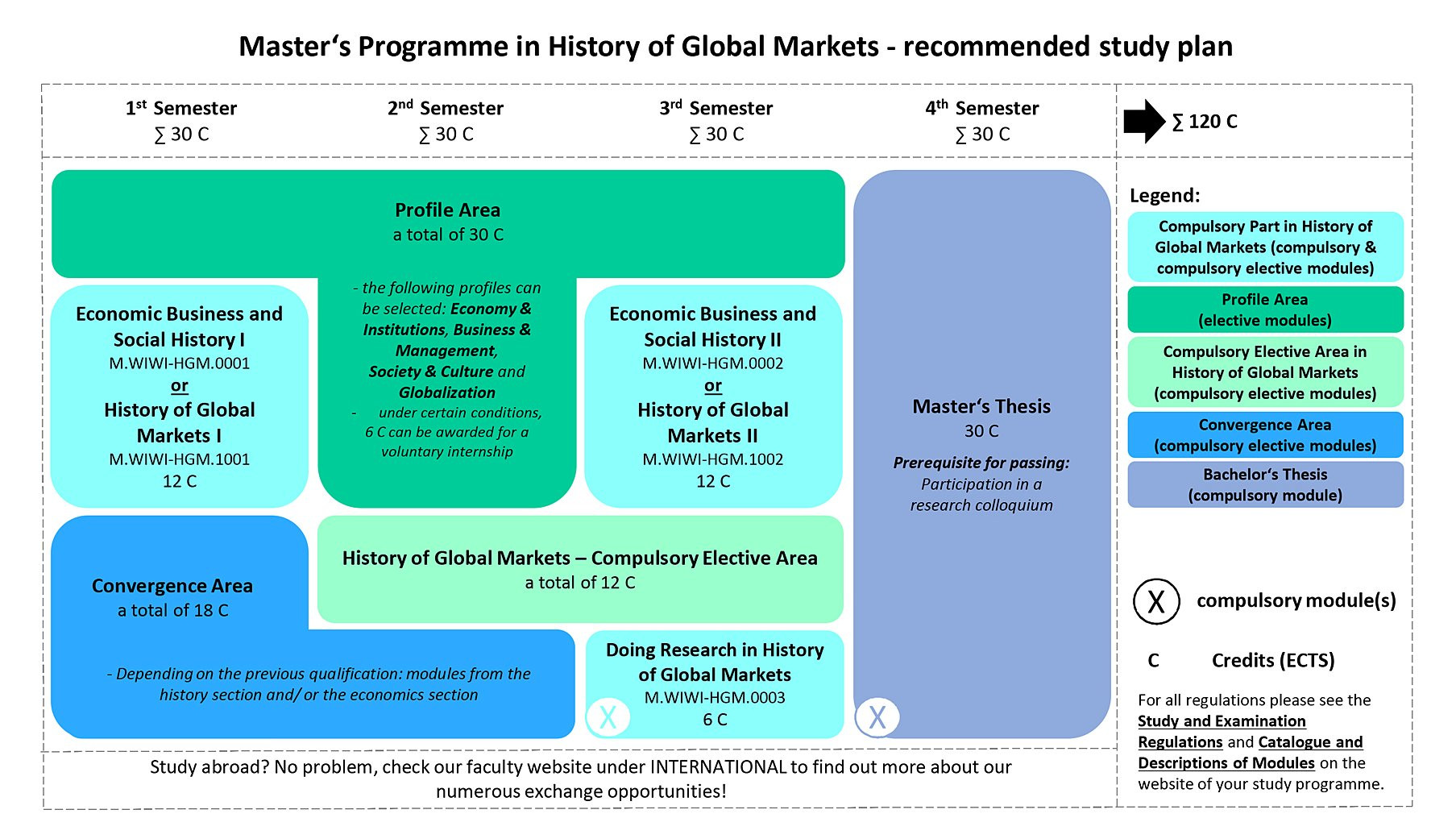
The "History of Global Markets" Master's degree programme is devoted to exploring these questions through historical methods. This history-focused degree programme imparts the analytical skills of economic and social history, and it combines these skills with building a profile either in economics, business studies, or the social sciences and history. This is not a typical business or economics degree. Our focus is on the historical development of the global economy as well as business history and the history of consumption.
The degree programme is open to those who have successfully completed a Bachelor’s degree programme in economic and social history, modern history, or an adjacent subject with a substantial background in both history and economics. You can commence the programme in the summer or the winter semester.
For students interested in a more present-day and interdisciplinary approach, the degree programme includes the "Global Markets, Local Creativities" (GLOCAL) option, which is part of an Erasmus Mundus Master's programme. This degree option is jointly offered by the universities of Glasgow, Barcelona, Uppsala, Rotterdam, Kyoto, Los Andes, and Göttingen, and you can apply for this degree option and EU scholarships directly: http://globallocal-erasmusmundus.eu/how-to-apply/
To draw insights from the past, our Master’s programme brings together economics and historical research, social and political sciences. In terms of methods, it goes beyond economic models and also uses qualitative and empirical methods. This multifaceted approach allows you to gain deep insights into the dynamic interactions between markets and societies. This gives you skills that prepare you for a wide range of careers – such as research, education, journalism, cultural management, consulting, politics and more.