International Programmes 2025/2026

Web Development (BSc) Web Development (BSc)

SRH University • Berlin

Degree
Bachelor of Science
Course location
Berlin
Teaching language
  • English
Languages

The programme is taught in English.

Full-time / part-time
  • full-time
Programme duration
7 semesters
Beginning
Winter semester
Additional information on beginning, duration and mode of study

Intake: October

Application deadline

Non-EU/EEA applicants: Please apply by 15 August (October intake). We also recommend that you apply early (at least four months before the start of your programme).

EU/EEA applicants: Please apply by 1 October (October intake).

Tuition fees per semester in EUR
4,740 EUR
Additional information on tuition fees
  • Non-EU/EEA tuition fees: 4,950 EUR per semester
  • EU/EEA (including Switzerland, Western Balkans and Ukraine) tuition fees: 790 EUR per month

Please note: The monthly/semester tuition fees remain the same for the entire duration of the study programme.

Joint degree / double degree programme
No
Description/content

The BSc programme in Web Development is practice-focused and business-aware. You will learn about project coordination by working in teams with designers, copywriters and marketing experts, advising customers, and creating concepts as well as implementing them. During the course of studies, students will work on assignments for customers, which we see as the ideal preparation for entry into job market.

During the internationally-recognised full-time Web Development programme, you will receive training as an interaction designer and web developer – with a single qualification. We will provide you with an understanding of social media, content engineering, script languages, software architecture and usability aspects. This forms a solid foundation for the targeted conception, development and visual design of apps, professional applications and online services as well as operating systems, virtual spaces and games. The complexity and variety of the projects will provide you with constantly new challenges and develop your skills. By working on current projects for business clients, you will be quick to establish valuable contacts at notable agencies and companies – from start-ups to global groups – and your entry into the job market will be made easy.

If you want to get even more work experience during your studies, you can switch to the dual version of the BSc Web Development programme at the beginning of any semester. You will need to have found a partner company before switching programmes though.

Course organisation

First semester

  • Design Basics I
  • Computer Science | Computer Architecture and Operating Systems
  • Computer Science | Programming
  • Communication Sciences
  • UX/UI Design and Gamification, Project Management (Cooperation Project)
  • Elective I

Second semester

  • Computer Science | Computer Networks and Internet Protocols
  • Information Architecture + Service Design Thinking
  • Usability Engineering UX + HX Design / Test Methods
  • Design and Media Studies
  • Software Engineering | Distributed Software Systems (Cooperation Project)
  • Elective II

Third semester

  • Mathematics I
  • UX/UI Information Psychology / UX Writing
  • Instructional Design + Digital Learning Environment
  • Content Marketing + SEO/SEM Strategy
  • Software Engineering | Cross-Platform Applications (Cooperation Project)
  • Elective III

Fourth semester

  • Mathematics II
  • Computer Science | Database Systems
  • Free Project Development / Competition
  • Deepening: Lab Project
  • Software Engineering | Content Management Systems (Cooperation Project)
  • Elective IV

Fifth semester

  • Internship
  • Free Project

Sixth semester

  • Computer Science | Introduction Data Science
  • Computer Science | Introduction to Artificial Intelligence
  • Scientific Colloquium
  • Game Design + Game Development | VR/AR Unity
  • Software Engineering | Embedded Systems and Internet of Things (Cooperation Projects)
  • Elective V

Seventh semester

  • Business Intelligence
  • Preparation BSc Thesis / Next Generation Development
  • Entrepreneurship and Media Law
  • Writing Workshop | BSc Thesis Preparation
  • Bachelor's Thesis
A Diploma supplement will be issued
Yes
International elements
  • International guest lecturers
  • Projects with partners in Germany and abroad
Integrated internships

In the fifth semester

Course-specific, integrated German language courses
Yes
Course-specific, integrated English language courses
No
Tuition fees per semester in EUR
4,740 EUR
Additional information on tuition fees
  • Non-EU/EEA tuition fees: 4,950 EUR per semester
  • EU/EEA (including Switzerland, Western Balkans and Ukraine) tuition fees: 790 EUR per month

Please note: The monthly/semester tuition fees remain the same for the entire duration of the study programme.

Semester contribution

None

Costs of living

Students may purchase a discounted semester ticket or a discounted "Deutschlandticket" for public transport.

Funding opportunities within the university
Yes
Description of the above-mentioned funding opportunities within the university
  • SRH offers partial scholarships for talented international students.
  • EU students can also benefit from our range of "study now – pay later" financing options.
  • Please check our website for more information here.
Academic admission requirements
  • General higher education entrance qualification (Abitur) or university of applied sciences entrance qualification (Fachhochschulreife)
  • CV
  • Proof of English-language proficiency
  • Copy of your identity card or passport
Language requirements

The following English proficiency tests are accepted:

  • TOEFL Internet-based: 87
  • TOEIC listening/reading: 785, speaking: 160, writing: 150
  • IELTS/IELTS Online (academic): 6.5
  • CAE (grades A, B, or C)
  • CPE (grades A, B, or C)
  • Pearson English Test Academic (PTE-A): 59 points
  • Linguaskill: 176 to 184 (CES) – all four skills required
  • B2 First: 173
  • Duolingo: 110 points
Application deadline

Non-EU/EEA applicants: Please apply by 15 August (October intake). We also recommend that you apply early (at least four months before the start of your programme).

EU/EEA applicants: Please apply by 1 October (October intake).

Submit application to

Please use our online application system to submit your application.

Possibility of finding part-time employment

Working as a non-EU citizen: In possession of a valid German residence permit for study purposes, you are allowed to work for up to 120 full days (full day = eight hours per day) or 240 half days (half day = four hours) during the calendar year. However, freelance work is not permitted. Internships that are mandatory for the successful completion of your studies at SRH do not count towards the above-named 120 full days.

Employment that is considered “student part-time work” ("studentische Nebentätigkeit", e.g. employment as a student worker at a university or in a university-related organisation or "Werkstudent" activities at companies that are related to your studies) can be done without any time restrictions.

Accommodation

We do not own any student dormitories or hostels. However, we provide assistance in selecting accommodation prior to and after your arrival in Berlin.

Career advisory services and programmes for future professionals

Our Career Service supports students and alumni in planning their careers and sharpening their professional profile. Our service portfolio includes:

  • Consultation services for students
  • Career trainings and workshops
  • Annual "Career Day" with job fair and workshops
  • Support in finding a job or an internship for graduates and students
Support for international students and doctoral candidates
  • Welcome event
  • Buddy programme
  • Specialist counselling
  • Support with registration procedures

SRH University

Content Bild
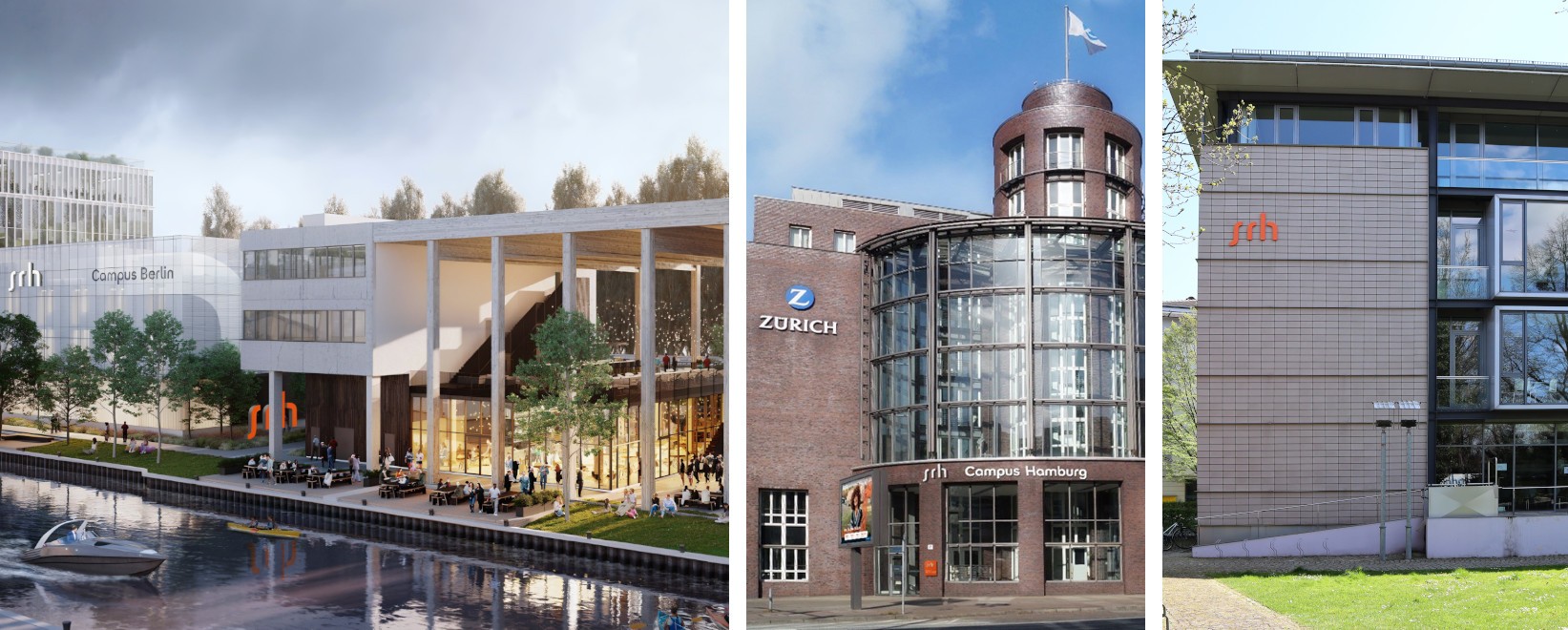
SRH University Campus Berlin © SRH University

We are the SRH University, part of the non-profit SRH Holding based in Heidelberg.

We offer state-accredited Bachelor's, Master's, and MBA programmes in English and German. Our curricula are built around the CORE Principle, emphasising hands-on, project-based learning in five-week blocks. Our programmes focus on management and logistics, engineering and architecture, computer and data science, hospitality and therapy, design and creative industries, and music and film.

With 19 campuses across Germany, we host a diverse student body from over 100 countries, contributing to our vibrant international atmosphere.

Our approach includes practical work experiences and professional networking opportunities, preparing students for successful global careers.

100+ Number of countries represented at our university
19 Number of campuses in Germany

University location

Berlin, Germany's capital, is a hub for politics, media, science, and education. It's the country’s largest city, offering a vibrant cultural scene with rich nightlife and historical sites. Berlin's dynamic start-up scene is attractive to tech and creative industries. Despite rising costs, it remains affordable compared to other Western European capitals.

Cologne is known for its relaxed culture, famous cathedral, and rich Roman history. It offers a vibrant academic and cultural scene with excellent job opportunities in media and other industries. Cologne is well-connected, making it easy to explore nearby cities.

Dresden combines a vibrant cultural scene with affordable living costs. Known for historical sights like the Zwinger and Semperoper, it offers good job prospects in microelectronics and IT. Its scenic location and rich cultural events make it an attractive city for students and young professionals.

Hamburg, Germany's second-largest city, is a major trade and logistics hub in north-western Europe. With a high standard of living and moderate costs, it offers career opportunities in IT, media, logistics, and renewable energy sectors. Famous for its harbour and nightlife, Hamburg is a city rich in water-related and cultural activities.

Hamm combines historical charm with modern innovation. It offers low living costs and affordable housing suitable for students. Home to Germany's first Bachelor's degree programme in logistics at the SRH Hamm campus, the city provides a close-knit community feel and is growing in industries like energy and logistics.

Heidelberg is known for its romantic ambiance and vibrant cultural and academic atmosphere. The city offers a picturesque landscape ideal for outdoor activities, with strong sectors in biotechnology, pharmaceuticals, and academia.

Leipzig is an economic hub with a growing population, offering career opportunities in technology, digitalisation, and life sciences. It has a vibrant music and cultural scene and remains one of Germany's more affordable major cities.

Stuttgart is a centre for technology and innovation, home to companies like Mercedes Benz and Porsche. It offers excellent educational and career prospects in engineering and sustainable technologies, supported by a vibrant cultural scene.

Munich, Bavaria's capital, is a leading German hub for economy, science, and education with high living standards. Home to top universities and research, it excels in high-tech industries, offering great careers. Near the Alps and lakes, it provides rich leisure options. Though pricier, its appeal and opportunities make it a desirable place to study and work.

Activate map

To activate the map, click on the "Show map" button. We would like to point out that data will be transmitted to OpenStreetMap after activation. You can find out more in our privacy policy. You can revoke your consent to the transmission of data at any time.