International Programmes 2026/2027

Molecular Biomedicine (MSc) Molecular Biomedicine (MSc)

University of Oldenburg • Oldenburg

Degree
Master of Science
Course location
Oldenburg
Teaching language
  • English
Languages

All modules are taught in English.

Full-time / part-time
  • full-time
Programme duration
4 semesters
Beginning
Winter semester
Application periods
The following is valid for applicants from: EU countries
For the winter semester:
15 March - 15 July
The following is valid for applicants from: non-EU countries
For the winter semester:
15 March - 30 April
More information on application periods
Please find more details on this website.
Combined Master's degree / PhD programme
No
Joint degree / double degree programme
No
Description/content

The Master's degree in Molecular Biomedicine combines the molecular life sciences with medicine by examining the molecular and cellular aspects of biology with special consideration of medical issues and problems. The explicit aim of the course of study is to convey the strong interdisciplinary approach of molecular biomedicine to the students and to overcome the subject boundaries between scientific and medical thinking through research-oriented project work.

The focus of the degree programme in “Molecular Biomedicine” is on the molecular mechanisms of cellular processes, whereby methods and the molecular understanding of the natural sciences are linked with current medical content. In the field of neuroscience, there is the possibility of specialising in key areas in:

  • biochemistry
  • genetics
  • molecular and cell biology
  • electrophysiology

A wide range of methods is used, ranging from microscopic techniques, heterologous gene expression and electrophysiological measurements to analysing the reactions of neurons in cell groups and in the intact nervous system to analysing behavioural patterns. Specialisation in cell and molecular biology basics, degenerative diseases as well as genetic diagnostic therapies and regenerative medicine is possible in neurogenetics, human genetics, genetics of childhood brain malformation, ophthalmology and geriatrics. Through a wide range of specialist training and instruction in various methodological and conceptual areas, the students are enabled to carry out basic scientific as well as clinical research in the field of molecular biomedicine independently. 

https://uol.de/studiengang/molecular-biomedicine-master-616

https://uol.de/en/molecular-biomedicine

Course organisation

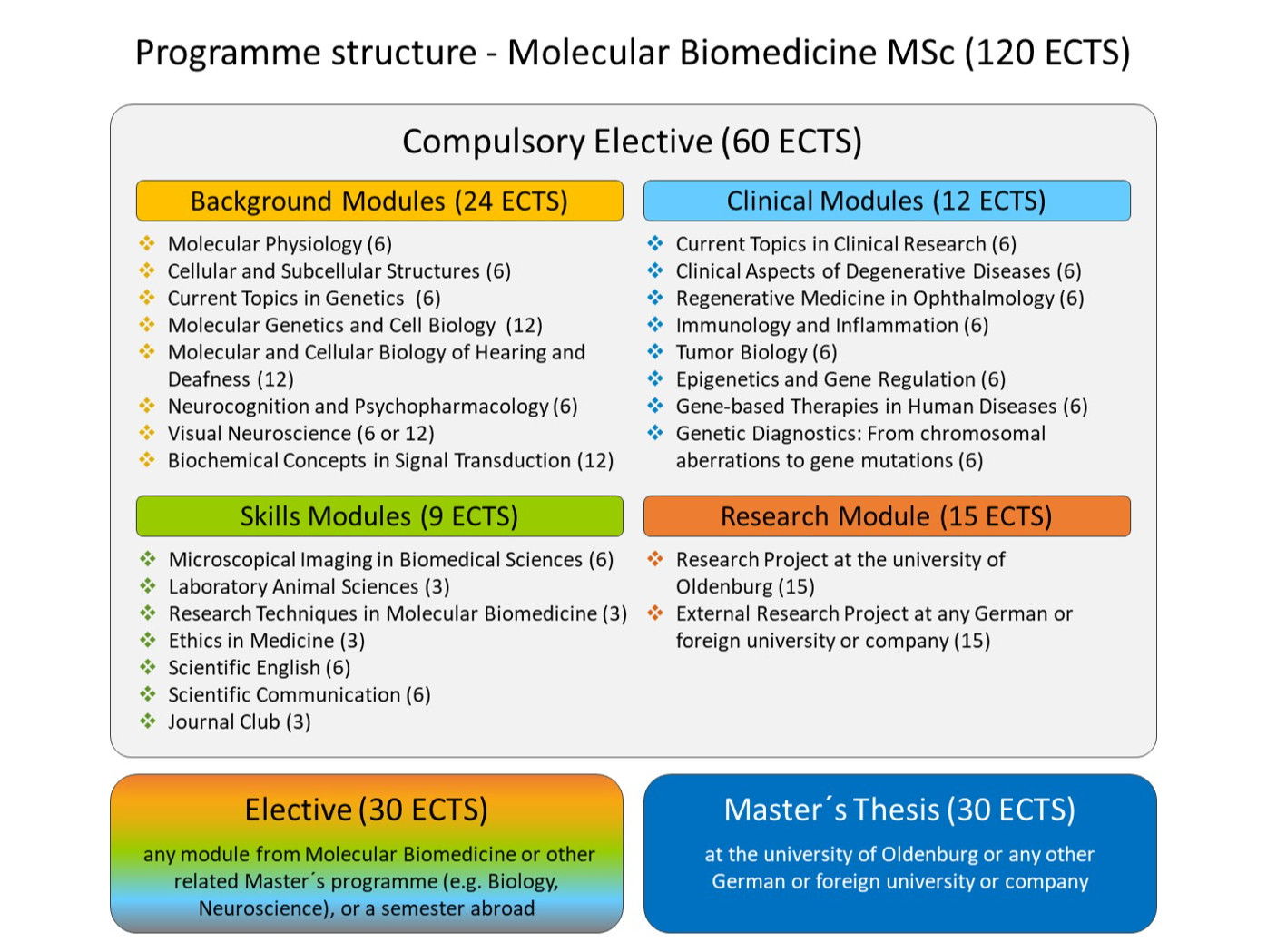
The research-oriented Master's programme with a total workload of 120 ECTS has a modular structure, comprising modules from the teaching units of medicine, neuroscience and biology. The curriculum is very flexible. You can choose modules depending on your interest and research profile and design your own study track. 

A Diploma supplement will be issued
Yes
International elements
  • Specialist literature in other languages
  • Language training provided
Description of other international elements

Research project(s) or the Master's thesis can be conducted abroad.

Integrated internships

At least one research project must be completed during the Master's programme. This can be accomplished at any German or foreign university or company.

Course-specific, integrated German language courses
No
Course-specific, integrated English language courses
Yes
Tuition fees per semester
None
Semester contribution

The semester contribution is approx. 435 EUR per semester. This includes a semester ticket that allows you to use public transportation.

https://uol.de/en/study-in-oldenburg/finances

Costs of living

You should expect to spend about 1,000 EUR per month to cover personal expenses (accommodation, health insurance and food).

https://uol.de/en/study-in-oldenburg/finances

Funding opportunities within the university
No
Academic admission requirements

Admission requirements

Bachelor's degree (or equivalent) with major in molecular life sciences, biochemistry, molecular biology, molecular biomedicine, genetics or immunology, in which at least 40 ECTS credits (including laboratory practice!) have been completed in at least three of the following subject areas: molecular biology, genetics, cell biology, developmental biology, biochemistry, immunology, human/animal physiology, molecular neurobiology.

Documents required

The following additional documents must be submitted along with your application in German or English:

  • A certificate of your Bachelor's or equivalent degree, including transcript of records and translations (certified for applications via the university)
  • Proof of English proficiency at level B2 or higher (no older than two years)
  • Completed specific eligibility form (available at uni-assist and the
    "Bewerbungsportal"; an application without this form cannot be considered)
  • If applicable, proof of additional qualifications (e.g. certificates concerning relevant work experience, internships or scientific projects, subject of the Bachelor's thesis, English language proficiency at C1 level, study-related stay abroad, voluntary social commitment)

Please make sure to include all relevant supporting documents in your application (especially information on internships and projects as well as the completed specific eligibility form). Do not submit motivation letters, as these will not be considered.

For more details on the admission procedure, please visit our website.

German language skills
No minimum language level required
English language skills
B2 required, please provide an official language certificate, e.g.:
  • TOEFL iBT (since 2026): 4
  • Reading: 4
  • Listening: 4
  • Speaking: 4
  • Writing: 4
  • IELTS Academic: 5.5
Application periods
The following is valid for applicants from: EU countries
For the winter semester:
15 March - 15 July
The following is valid for applicants from: non-EU countries
For the winter semester:
15 March - 30 April
More information on application periods
Please find more details on this website.
Submit application via
Please apply via uni-assist.
Possibility of finding part-time employment

Students are permitted to work alongside their studies. If you are a student from a non-EU country, you are allowed to work 140 full days or 280 half days per year.

Accommodation

The University of Oldenburg does not own or manage any dorms and thus cannot provide or guarantee your housing! The Studierendenwerk Oldenburg runs halls of residence for students, but waiting times may occur. Arranging for temporary housing prior to your arrival is recommended.

Further information

Career advisory services and programmes for future professionals
  • Individual study and career counselling by the programme coordinator
  • Study and career counselling service of the university
  • Career Day of the university
  • Neuroscience Career Day (organised by students)
Support for international students and doctoral candidates
  • Welcome event
  • Specialist counselling
  • Buddy programme
  • Tutors
  • Cultural and linguistic preparation
General services and support for international students and doctoral candidates

Information for international degree students

For details, please contact the adviser for international students at the International Office.

University of Oldenburg

The University of Oldenburg was founded in 1973, making it one of Germany‘s youngest universities. Its goal is to find answers to the major challenges society faces in the 21st century – through interdisciplinary, cutting-edge research.

University location

Oldenburg looks back on more than 900 years of history and is now, with its +176,000 inhabitants, a centre of cultural, scientific and economic life in the region of North-West Germany.

Oldenburg is a great place to live. With a wide range of pubs, restaurants, theatres and museums, this city will keep you entertained, and it is also a safe place. Bicycles are the preferred means of transport, and drivers are considerate. Oldenburg also has an excellent bus system, and your semester ticket allows you to use local transport in all of Germany for free. A green city in more ways than one, Oldenburg offers frequent bus and rail connections to German and European cities. For example, Berlin is just a four-hour train ride away, and you can get to Hamburg in two hours.

Activate map

To activate the map, click on the "Show map" button. We would like to point out that data will be transmitted to OpenStreetMap after activation. You can find out more in our privacy policy. You can revoke your consent to the transmission of data at any time.