Leibniz University Hannover – global thinking, interdisciplinary research: the spirit of Leibniz!
As one of the nine leading institutes of technology in Germany, Leibniz University Hannover is aware of its responsibility in seeking sustainable, peaceful, and responsible solutions to the key issues of tomorrow. Our expertise for this stems from the broad spectrum of subjects, ranging from engineering and natural sciences to architecture and environmental planning, and from law and economics to social sciences and humanities.
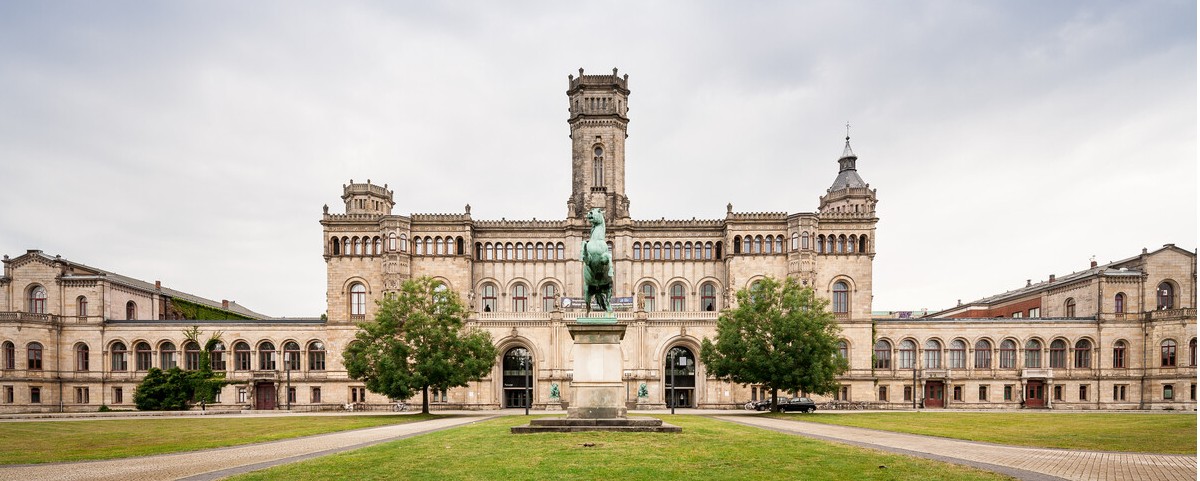
The main building of the university is the Royal Welfenschloss (Palace of the Guelphs) at Welfengarten Park. In 1879, the Higher Vocational School, originally founded in 1831, moved into the palace. Later, it became the "Königliche Technische Hochschule" (Royal College of Technology). By adopting the name of the polymath Gottfried Wilhelm Leibniz in 2006, the university committed itself to unity in diversity.
Universality — our strength is rooted in diversity
Our broad spectrum of subjects ranges from engineering and natural sciences, architecture and environmental planning, law, social sciences, economics and management to the humanities. Only a few universities in Germany provide such a varied range of subjects. We are committed to further developing our profile, while attaching particular importance to interdisciplinary teaching and research.
Our key research areas
Leibniz University Hannover is among the world's leading institutions in its key research areas: biomedical research and engineering, quantum optics and gravitational physics, production engineering, and interdisciplinary studies of science and academia. These give us our innovative strength in developing precision measurement methods, optical technologies, novel materials, intelligent implants, and innovations in information technology or in the field of Industry 4.0.
The broad range of subjects at Leibniz University Hannover is entirely compatible with the overall university strategy of raising its profile, in particular in teaching and research, including the establishment and enhancement of research priority areas originating in the humanities and social sciences. Cooperation agreements with national and international partners strengthen our scientific expertise — our most important partner is Hannover Medical School.