International Programmes 2026/2027

Master of Arts in Digital and Computational Archaeology Digital and Computational Archaeology

University of Cologne • Köln

Degree
Master of Arts
Course location
Köln
Teaching language
  • English
Languages

All courses are taught in English. Students can choose whether to submit coursework, assessments, and exams in English or German.

Full-time / part-time
  • full-time
Programme duration
4 semesters
Beginning
Winter semester
Application periods
The following is valid for applicants from: all countries
For the winter semester:
until 1 September
More information on application periods
Please find more details on this website.
Combined Master's degree / PhD programme
No
Joint degree / double degree programme
No
Description/content

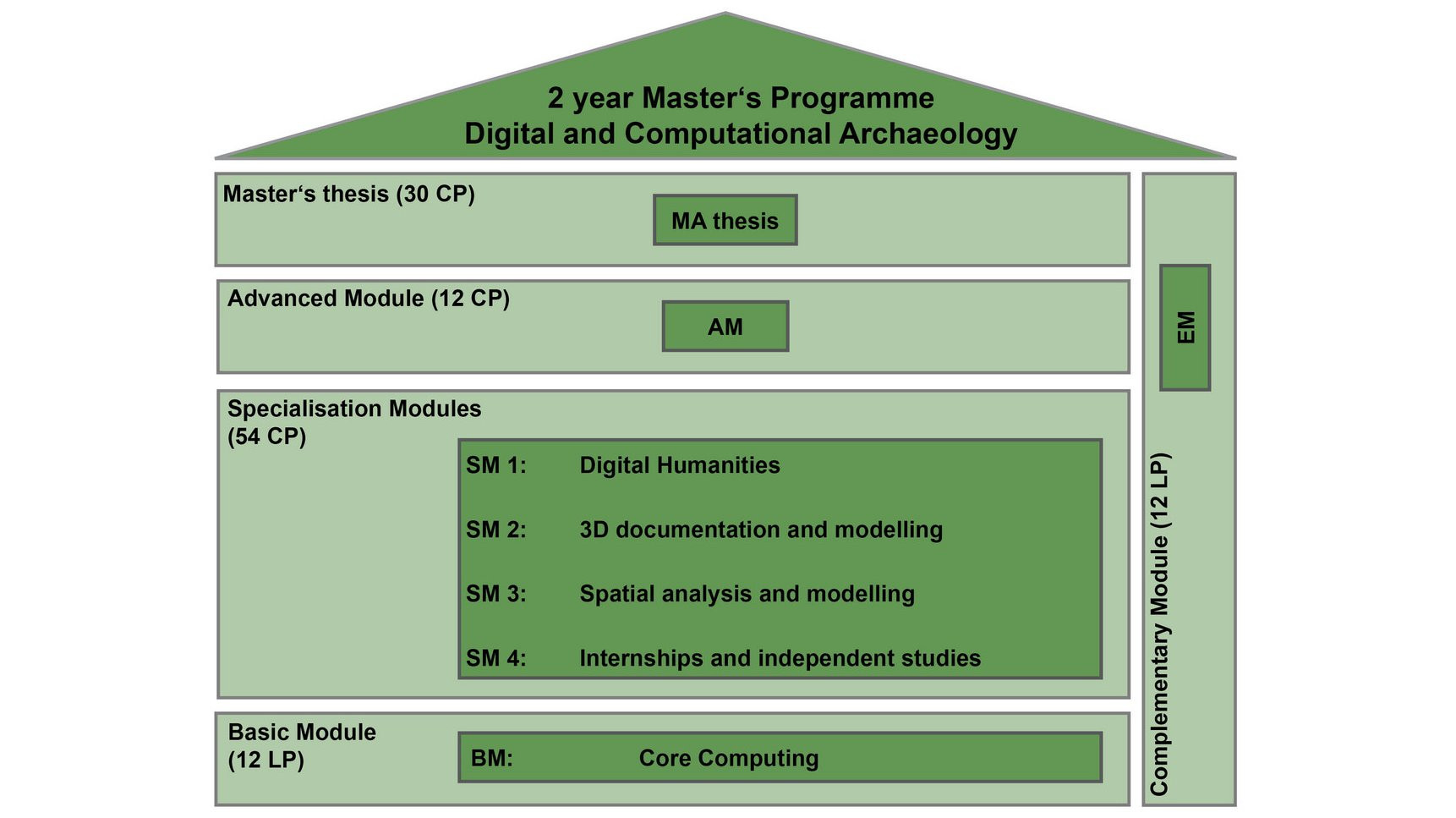
Digital and Computational Archaeology is concerned with the development and application of digital technologies and computational methods in archaeology. The Master of Arts in Digital and Computational Archaeology is designed to equip archaeology graduates with practical, theoretical, and critical skills in a variety of established and emerging digital technologies, and support a career in academia, cultural resource management, and museums as well as public and private cultural heritage organisations. Students of this programme will develop skills in data science, web technologies, data modelling and database design, 2D and 3D digital documentation, GIS, spatial analysis, statistics, programming, and computational modelling. They will also be offered the opportunity to use the facilities of the Cologne Digital Archaeology Laboratory (CoDArchLab), which is equipped with teaching, research, and study spaces; numerous workstations; a variety of commercial and open-source software programmes; and specialised computational imaging equipment.

Students of the MA Digital and Computational Archaeology will have the opportunity to...

  • develop core computing skills in data science (database theory and design, data visualisation, and representation), web technologies, and programming (Python, R), and become acquainted with current issues in archaeological data management and policy.
  • familiarise themselves with the use of state-of-the-art 3D technologies and media and learn which techniques are best suited for data capture, documentation and analysis in different situations and contexts (e.g. fieldwork, museum, research projects).
  • think critically on the application of geographic information systems (GIS), spatial analysis, and computational modelling in archaeology, and learn how to best apply computational methods to gain insight into the socio-political organisation of past societies.
  • learn to identify current issues, problems and developments in the field of digital humanities and gain practical experience in the application and development of methods and tools that can benefit humanities research more broadly.
  • take work placements ("Praktika") in excavations, museums, or cultural heritage management organisations and test their practical skills in real life situations.
Course organisation
PDF Download
A Diploma supplement will be issued
No
International elements
  • International guest lecturers
  • Projects with partners in Germany and abroad
  • International comparisons and thematic reference to the international context
Integrated internships

The study programme includes internships ("Praktika") that can take place in Cologne or in other places in Germany or abroad.

Course-specific, integrated German language courses
No
Course-specific, integrated English language courses
No
Tuition fees per semester
None
Semester contribution

Each semester, all enrolled students of the University of Cologne have to pay a social fee ("Semesterbeitrag") of 335.65 EUR. The social fee consists of a social contribution fee for the "Kölner Studierendenwerk" (KSTW) as well as for the General Students' Committee ("AStA"). Additionally, it finances university sports and the "semester ticket" (use of public transport in Germany).

Costs of living

The cost of living in Cologne is in line with the EU average. You will need approx. 986 EUR each month to cover your living expenses (food, accommodation, clothing, cultural events, etc.).

For more information visit the "Costs & Financing" pages of the University of Cologne.

Funding opportunities within the university
Yes
Description of the above-mentioned funding opportunities within the university

The University of Cologne offers a scholarship programme for German and international students. The programme consists of three grants:

  • Deutschlandstipendium des Bundes
  • Sozialstipendium der Universität zu Köln (social scholarship)
  • Stipendium für Studierende mit Behinderung oder chronischer Erkrankung (scholarship for students with disabilities and chronic diseases)

All grants are 300 EUR per month and are awarded depending on the respective academic performance. For the "Sozialstipendium" and the "Stipendium für Studierende mit Behinderung oder chronischer Erkrankung", social criteria are decisive as well.

Academic admission requirements

Applicants for the Master of Arts in Digital and Computational Archaeology should hold a Bachelor’s degree (with at least 180 CP) in archaeology or an archaeological subdiscipline, such as Prehistoric Archaeology, Classical Archaeology, Ancient West Asian Studies, Archaeology of Roman Provinces, Egyptology, or similar. Bachelor-graduates of neighbouring subjects may also be admitted after case-by-case-review if at least 60 CPs have been obtained in an archaeological sub-discipline during the BA studies. A decision upon the admission of students will be made by the admissions committee.

German language skills
No minimum language level required
English language skills
C1 required, please provide an official language certificate, e.g.:
  • IELTS Academic: 7
Language requirements exemptions
Please find details on the course website.
Application periods
The following is valid for applicants from: all countries
For the winter semester:
until 1 September
More information on application periods
Please find more details on this website.
Submit application via
Please apply via uni-assist.
Possibility of finding part-time employment

Currently, students of Digital and Computational Archaeology with German language skills hold part-time jobs in museums, state cultural heritage organisations, or excavation projects. Furthermore, students that have completed the first year of the MA may find jobs as student research assistants in projects of the Cologne Digital Archaeology Laboratory (limited places).

Please note the legal requirements for working while studying.

Accommodation

The Kölner Studierendenwerk operates 90 student dormitories with 5,000 spots for students from all of Cologne’s universities, including spots for students with children or families. In addition to the student dormitories operated by the "Kölner Studierendenwerk", an array of private student dormitories operated by other institutions exists as well. Applications to any of the above student dormitories must be submitted by the applicant as early as possible (three to six months prior to moving in). Please note that the rooms are highly desired and scarce, so the probability of being assigned a room in one of the student dormitories is low.

For more information, visit the relevant webpages of the International Office.

Career advisory services and programmes for future professionals

The University of Cologne offers a host of services for enrolled international students, including career advisory services for working in Germany and abroad.

Support for international students and doctoral candidates
  • Specialist counselling

University of Cologne

University location

Activate map

To activate the map, click on the "Show map" button. We would like to point out that data will be transmitted to OpenStreetMap after activation. You can find out more in our privacy policy. You can revoke your consent to the transmission of data at any time.