International Programmes 2026/2027

Master of Arts in English Linguistics English Linguistics

Trier University • Trier

Degree
Master of Arts
Course location
Trier
Teaching language
  • English
Languages

Courses are taught in English. Some courses in elective courses may be taught in German.

Full-time / part-time
  • full-time
Programme duration
4 semesters
Beginning
Winter and summer semester
Application periods

Non-EU citizens:

  • 15 January 2027 for the summer semester 2027 (admission also valid for the winter semester 2027/28)
  • 31 May 2027 for the winter semester 2027/28 (admission also valid for the summer semester 2028)

German citizens, EU citizens, and applicants with a BA or MA degree from a German university:

  • 15 March 2027 for the summer semester 2027 (admission also valid for the winter semester 2027/28)
  • 15 September 2027 for the winter semester 2027/28 (admission also valid for the summer semester 2028)
More information on application periods
Please find more details on this website.
Combined Master's degree / PhD programme
No
Joint degree / double degree programme
No
Description/content

The English-taught MA degree programme in English Linguistics (single-subject) is a two-year programme that aims to teach students in-depth knowledge and skills in English linguistics with a special thematic focus on linguistic variation. Students will learn about how contextual, social, regional, and psycholinguistic factors shape language, as well as how language varies over time (language change). In addition to this, students will acquire a broad spectrum of methodological skills pertaining to gathering and analysing quantitative data in linguistics, which promotes general data literacy.

Due to the practical and hands-on nature of the programme, students will not just be learning these skills in the classroom; the English Linguistics MA degree programme includes a research-based or vocational internship. This not only helps students gain perspective on their future careers but also gives them the opportunity to hone their skills and put them into practice.

Starting in their second semester, students can study abroad and profit from our partnerships with universities in Great Britain and France.

The English Linguistics Master’s programme also has a strong interdisciplinary component with four areas of elective courses to choose from: Anglophone Literatures and Media; Natural Language Processing; Digital Humanities; Phonetics. These subjects tie in well with linguistics and, at the same time, they enable students to pursue further interests and flesh out their individual profiles.


Course organisation

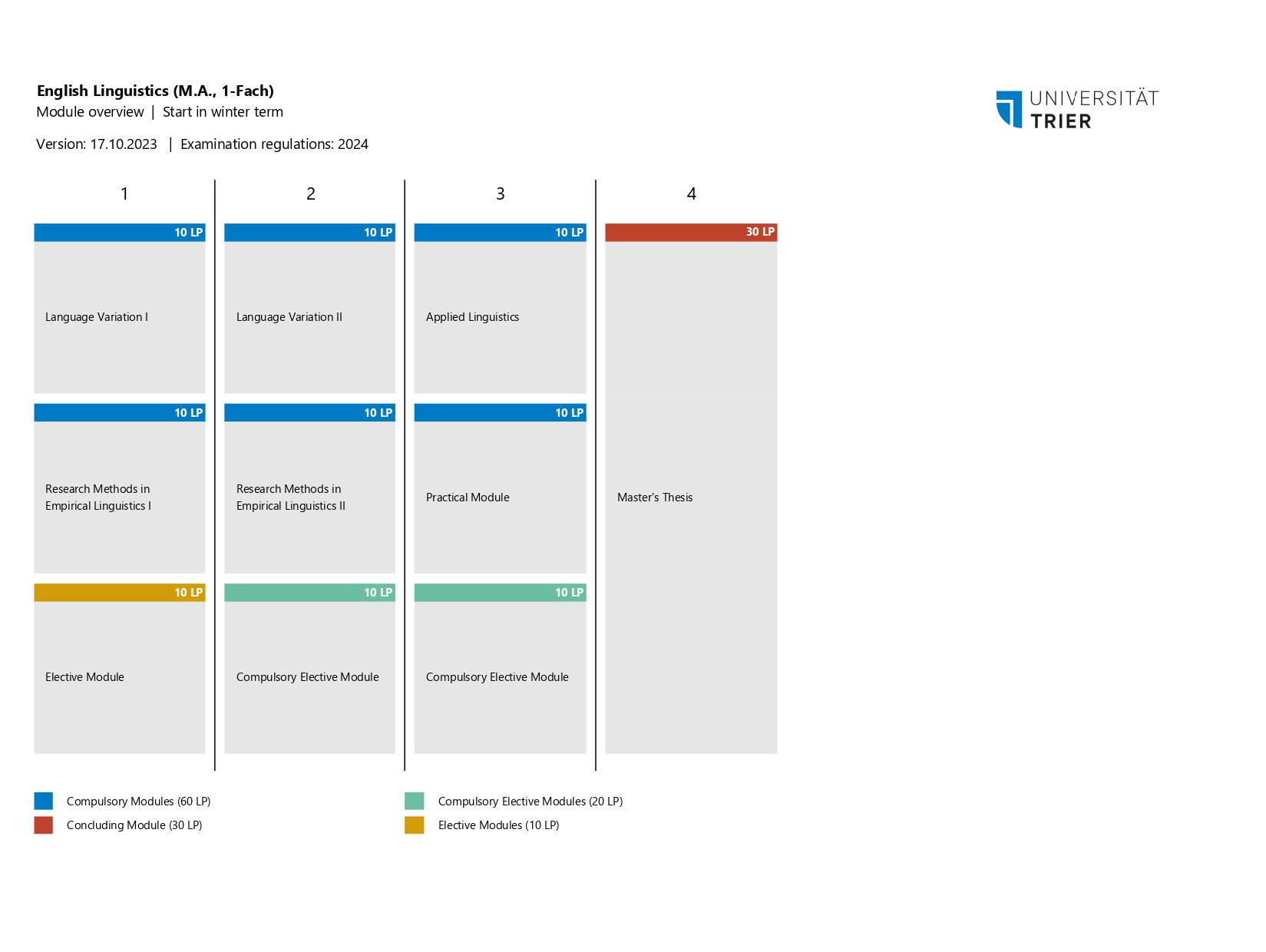
The programme consists of ten modules over the course of four semesters:

  • First semester: Module 1 "Language Variation I" & Module 2 "Research Methods in Empirical Linguistics I" plus one elective module chosen from another discipline 
  • Second semester: Module 3 "Language Variation II" & Module 4 "Research Methods in Empirical Linguistics II" plus one compulsory elective module chosen from another discipline
  • Third semester: Module 5 "Applied Linguistics" & Module 6 "Practical Module" plus one compulsory elective module chosen from another discipline 
  • Fourth semester: Module 7 "Master's Thesis"

Courses are taught as seminars and project-based seminars. The "Practical Module" (Module 6) consists of an academic or professional full-time internship (duration: six weeks). Students complete their studies with Module 7 where they write their Master's thesis and defend it. In addition, students complete three elective modules of their own choice from a wide range of subjects (e.g. natural language processing, phonetics, etc.).  

PDF Download
International elements
  • Language training provided
  • Training in intercultural skills
  • International guest lecturers
  • Integrated/optional study abroad unit(s)
Integrated/optional study abroad unit(s)

Starting in their second semester, students can study abroad. They can profit from our partnerships with universities in Great Britain (Lancaster University) and France or choose another partner university.

Integrated internships

The degree programme includes a research-based or vocational full-time internship (Module 6) in the third semester, with a duration of six weeks. 

Course-specific, integrated German language courses
No
Course-specific, integrated English language courses
No
Tuition fees per semester
None
Semester contribution

Trier University does not charge tuition fees. Students only have to pay a semester contribution of approx. 380 EUR for the first semester and 360 EUR from the second semester onwards. This includes the "Deutschlandticket", which covers public transport and local trains all over Germany. The contribution also benefits Trier Student Services and the student union. It also enables students to buy meals at reduced prices at the university's canteens.

Costs of living

Students should expect expenses of approx. 1,000 EUR per month. For instance, monthly housing costs are approx. 290 to 400 EUR (in a student's dormitory or a room in a shared flat) and 450 to 650 EUR (for a single apartment on the private market). A meal in the student cafeteria costs approx. 3.50 to 5 EUR.

Funding opportunities within the university
Yes
Description of the above-mentioned funding opportunities within the university

Trier University offers some funding opportunities for international students in the final stage of their degree programmes (maximum duration: six months). However, there are no funding opportunities within the university for the whole course of study or the first three semesters of the programme.

Academic admission requirements
  • Bachelor's degree in English Studies, American Studies, General Linguistics, or an equivalent degree. Equivalency is determined by the examination board (Prüfungsausschuss) in individual cases.
  • Module with at least 10 CP from the area of English Linguistics * **
  • Proof of English language proficiency in accordance with § 4 Abs. 2 of the current Einschreibeordnung (enrolment regulations) of Trier University.

See this link for current enrolment regulations of Trier University (in German).

* If your transcript of records does not include explicit references to classes in English linguistics even though they were part of your studies, you may upload additional materials to prove this.

** Please understand that we define English linguistics as “the linguistic study of the English language”. General linguistics classes that were only taught in English but did not actually cover anything about the linguistics of the English language in particular cannot be counted as classes in English linguistics.

German language skills
No minimum language level required
English language skills
C1 required, please provide an official language certificate, e.g.:
  • UNIcert® English: UNIcert® III
  • TOEFL iBT (since 2026): 4.5
  • TOEFL iBT (before 2026): 80
  • IELTS Academic: 6.5
  • Cambridge English Qualifications: C1 Advanced
Language requirements exemptions
Please find details on the course website.
Application periods

Non-EU citizens:

  • 15 January 2027 for the summer semester 2027 (admission also valid for the winter semester 2027/28)
  • 31 May 2027 for the winter semester 2027/28 (admission also valid for the summer semester 2028)

German citizens, EU citizens, and applicants with a BA or MA degree from a German university:

  • 15 March 2027 for the summer semester 2027 (admission also valid for the winter semester 2027/28)
  • 15 September 2027 for the winter semester 2027/28 (admission also valid for the summer semester 2028)
More information on application periods
Please find more details on this website.
Submit application via
Please check this website.
Possibility of finding part-time employment

Students from the European Union, Iceland, Liechtenstein, Norway and Switzerland enjoy unrestricted access to the German labour market. International students from other countries are allowed to work 120 full days or 240 half days per year.

The Career Service of Trier University and the "Agentur für Arbeit" provide an online database for student jobs. Job offers can also be found on the website of the "Bundesagentur für Arbeit": https://jobboerse.arbeitsagentur.de.

Additionally, some temporary student jobs can be found on the university's bulletin boards. However, many job offers will require at least some knowledge of German.

Accommodation

Accommodation is available in student halls of residence through the Student Services Office (Studierendenwerk Trier: http://www.studiwerk.de) or on the private market (for more information: www.study-in-trier.de). Monthly housing costs are approx. 290 to 400 EUR (for a basic dorm room with a shared bathroom) and 450 to 650 EUR (for a single apartment on the private market).

Career advisory services and programmes for future professionals

Trier University's Career Service offers special information sessions and workshops in English for international students planning to start their career in Germany after finishing their degree. 

https://www.uni-trier.de/en/studies/career-service

Support for international students and doctoral candidates
  • Welcome event
  • Buddy programme
  • Tutors
  • Accompanying programme
  • Cultural and linguistic preparation
  • Support with registration procedures
General services and support for international students and doctoral candidates

Orientation Seminar "Quick Start" (free of charge):

  • Support with all formalities at the start of your studies
  • Information: work and residence permit in Germany, financing your studies/scholarships, health insurance and healthcare system in Germany
  • Networking opportunities: overview of organisations and useful contacts for international students at Trier University & meeting with other students during social/cultural events
  • Orientation on campus and in the city: guided tour on campus and in the city centre
  • Workshops: understanding cultural similarities and differences, academic writing, studying successfully, presenting successfully, digital learning and communication

German as a foreign language: courses at all levels A1 through C1 (free of charge)

Trier University

Content Bild
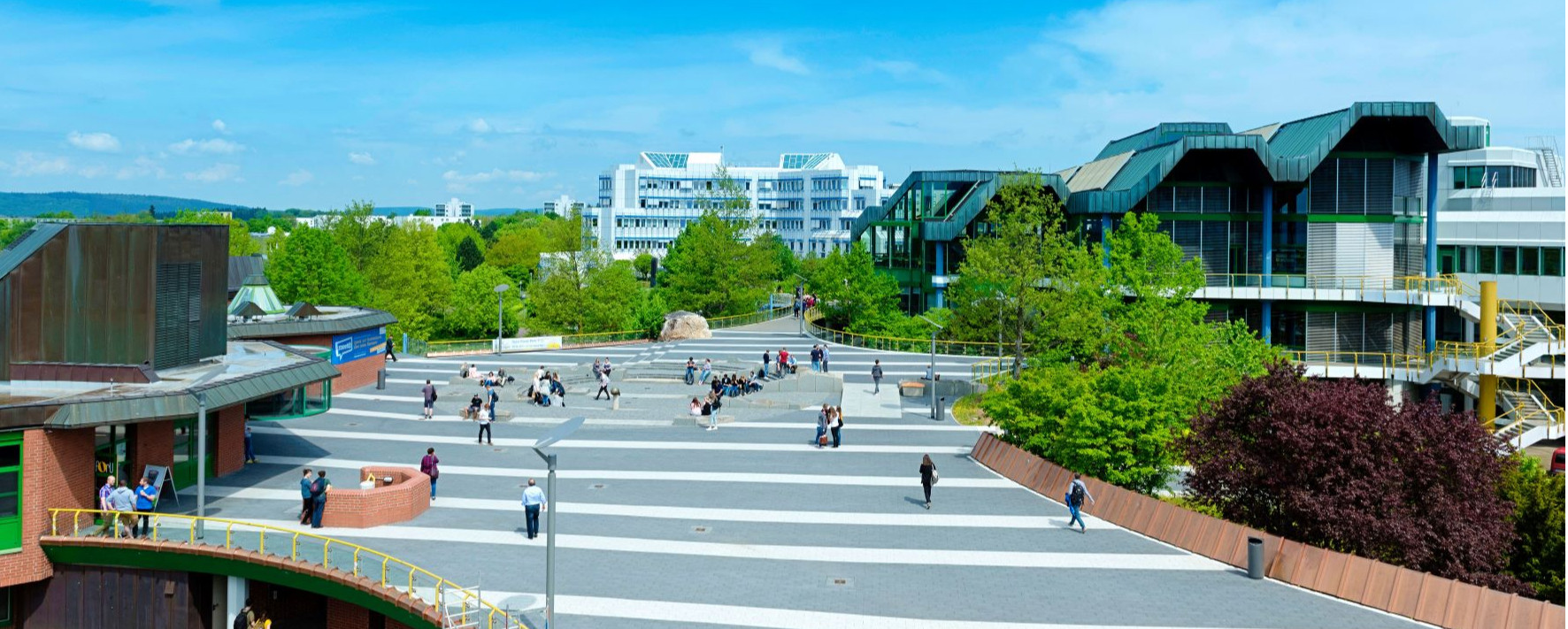
Trier University Central Forum © Universität Trier

With an open eye for the individual and society...

... we create innovation.

... we share knowledge.

... we bridge borders.

Trier University was founded in 1473, and it reopened in 1970 as a modern campus university. Built on a high plateau overlooking the Moselle River and surrounded by luscious green nature, it is said to be one of Germany's most beautiful campuses. Faculty and departmental buildings are connected by bridges and grouped around the forum and the central library.
Trier University has a strong focus on the humanities, social sciences, and economics, but it is also steadily strengthening its information science and environmental science programmes. There are six faculties that together cover more than 30 subject areas. Many research projects are interdisciplinary in nature and embedded in global networks.
With its roughly 1,200 employees and 10,500 students (including about 19% international students), Trier University embraces contrast: young yet true to tradition, internationally oriented yet regionally rooted, and at the geographic edge of Germany but in the heart of Europe.

http://www.uni-trier.de

Mission statement: https://www.uni-trier.de/en/university/about-trier-university/translate-to-englisch-leitbild

9 English-taught Master's programmes
4 Countries within an hour of travel

University location

Trier is situated in the western part of the federal state of Rhineland-Palatinate in the Moselle Valley. The city is proud of its rich history, which is reflected in its museums and its many historical sites. Thanks to its landmarks, the Porta Nigra, the Trier Cathedral, and other significant architectural monuments, Germany's oldest city was declared a UNESCO World Cultural Heritage Site.
Today's cityscape is a fusion of history and modern lifestyle, not least characterised by a vibrant student life. With bars, cafés, and a colourful range of cultural offerings and festivals, Trier is a tourist attraction with international appeal and a beautiful place for the city's 110,000 residents to live.
The city's economy is characterised by a few major enterprises and many medium-sized businesses. Trier is in the heart of Europe, as evidenced by its proximity to Luxembourg, which is an important financial centre and the site of several EU institutions, as well as its proximity to France and Belgium. Nine twin towns and cities across Europe, Asia, and the USA attest to Trier's international orientation.

http://www.trier.de

Activate map

To activate the map, click on the "Show map" button. We would like to point out that data will be transmitted to OpenStreetMap after activation. You can find out more in our privacy policy. You can revoke your consent to the transmission of data at any time.